
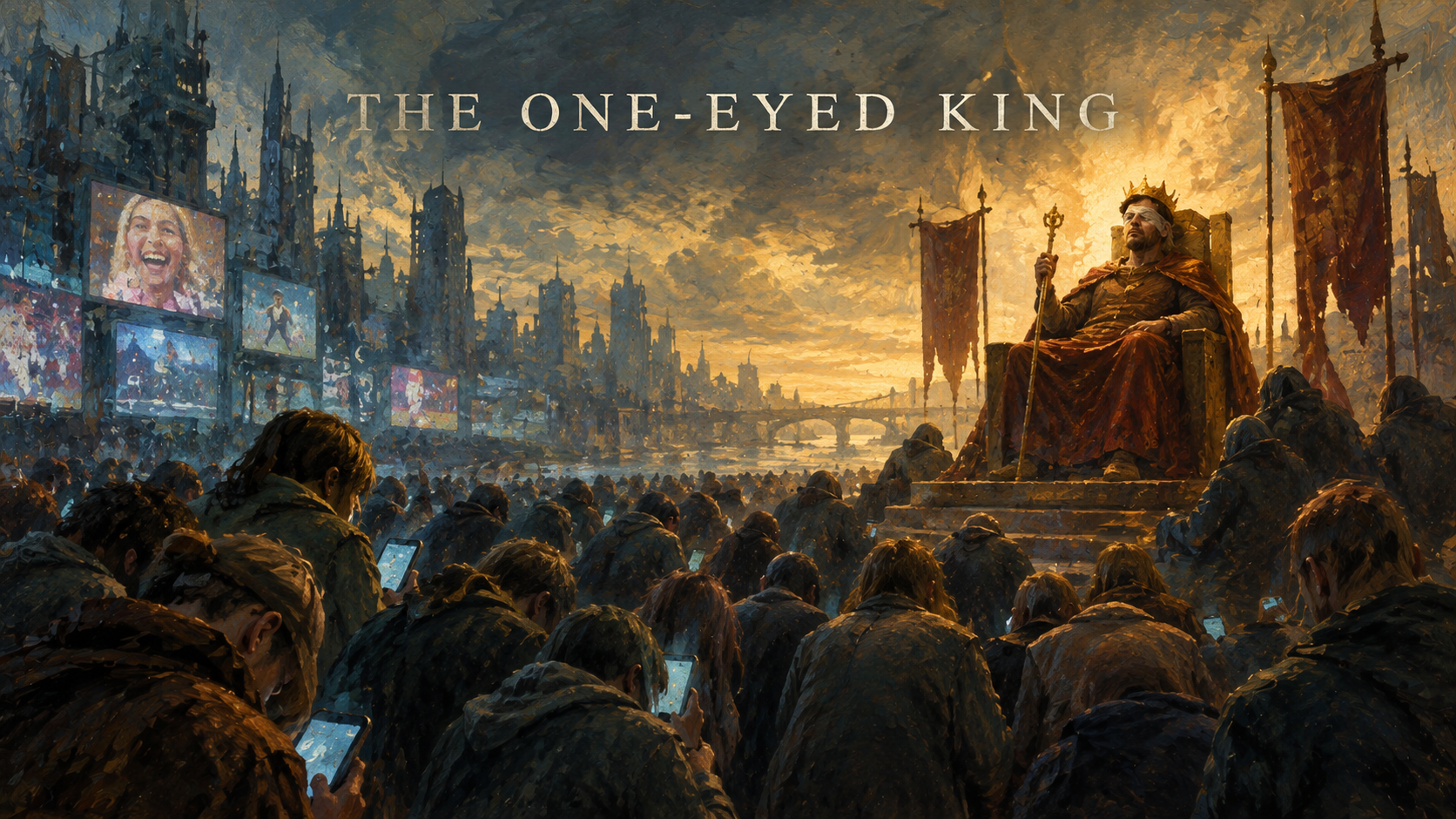
On a song about blindness, amusement, and who gets crowned
Everyone knows the proverb: in the land of the blind, the one-eyed man is king. We hear it as a story about the clever outsider who rises. “The One-Eyed King” asks a darker question. What does it say about a people when a half-blind man is the best they can do, and when they kneel to him by choice?
The Sealed Eyes
The first verse describes a people who “have sealed their eyes to the ancient Light, / and traded the long gaze for a wall of screens.” The blindness is precise. These people can see plenty. They watch the “theater of noise where the sleepers play.” What they’ve lost is the long gaze, the patient kind of looking that holds still long enough to see what matters.
Huxley’s fingerprints are everywhere. “Soma drips down through every open vein,” and the world is one “where pleasure is demanded,” a phrase that captures the central strangeness of Brave New World: happiness there is a civic duty. Note what dies in the process: “the silence dies between.” Silence is the first casualty of an age that cannot bear an empty moment.
The Inversion
The chorus takes the proverb and turns it against itself. The king “crawls through smoke in a borrowed shade, / and they kneel for the little light he brings.” He doesn’t stride, and even his sight is borrowed. The people kneel, and kneeling is the posture reserved for something worthy.
Then the song states its thesis:
Not because he sees the Holy City,
Not because he knows the Way—
Only because the rest have chosen
To call their rot the breaking day!
The crucial word is “chosen.” Nobody forced this king on them. The blindness is a decision, and the song places the responsibility where Huxley placed it: with the people who prefer their condition.
A King Like Any of Them
The second verse is where the song grows beyond polemic. The king is no villain. He is “weak in wisdom, weak in will, / scarred by the self-same poison in their blood.” He rules not by any real vision but “by relative degree,” following “the least-impaired among the blind.” That phrase is the song’s sharpest, since it names a whole way of choosing leaders: by comparison with their neighbors, never by any standard.
His throne is “a ruined, half-blind eye… a throne of wood,” a flimsy seat that cannot help but suggest another wooden throne, the one the true King occupies.
Glass and Bread
In the third verse, the king is “a hollow, painted prophet in a hall of glass,” and his people “feed on shattered glass and call it bread.” Readers of “Glass in My Teeth” will recognize the image from the other side. In that song, a narrator speaks truth “like glass, not bread.” Here, the audience eats it. Taken together, the two songs show both ends of the same transaction.
Then comes the argument at the center of the song, carried by the swelling backing vocals:
No chains are needed here, no iron grip,
No Grand Inquisitor with fire and sword—
For joy itself has done the tyrant’s work,
And amusement is their lord!
This is the old comparison between Orwell and Huxley in four lines. Orwell feared the boot, and Huxley feared that no boot would be needed. Neil Postman made the contrast famous in Amusing Ourselves to Death, and this song is firmly on Huxley’s side of it. “Joy itself has done the tyrant’s work” is the line that explains why.
The Other King
The bridge opens with an ellipsis, as if a thought were resuming after a long silence: “…But the King who opened blind men’s eyes / still walks the road they buried in the dust!” This King does not reign “by damaged, flickering sight.” He burns away vanity.
The moral center follows:
Better the blind beggar crying out for grace,
Outside the city gate in rags and pain—
Than the crowned fool who wears a stolen eye,
Inside a deadened, dark domain!
The beggar outside the gate recalls blind Bartimaeus, crying out for mercy on the road out of Jericho. His cry is the ancestor of “Lord, have mercy,” and the song is quietly setting up its final line. It also answers “Glass in My Teeth,” where the narrator insisted that he was “not a beggar at the doorway / but a captain at the plank.” In this song’s moral order, the beggar has it right.
“Our”
For three verses and a bridge, the song speaks of “they” and “he.” They sealed their eyes, they follow, they feed on glass. It’s an accusation from a height, and the listener may wonder who is speaking and from where.
The final chorus answers that: “Open our eyes, O Lord of living fire, / before the dark claims all our trust!”
Our. For the first time, the narrator counts himself among the blind. The man who was pointing at the crowd turns out to be standing in it, and the song’s last lesson is that the one-eyed king may be anyone who believes he sees better than his neighbors. The loftiness of the verses is deliberate. It is the trap that the song springs on itself.
The Prayer
The outro offers no victory. It offers a petition:
Before the dark calls itself the world.
Before the blind crown another fool.
“Before the dark calls itself the world” names the moment a condition becomes invisible because everyone shares it. Then the song closes on the beggar’s cry, “Lord, have mercy,” twice.
A prayer is by nature unresolved. It asks, and the answer is not in the song. That seems right for a piece about people who have lost the habit of asking.
Leave a Reply