
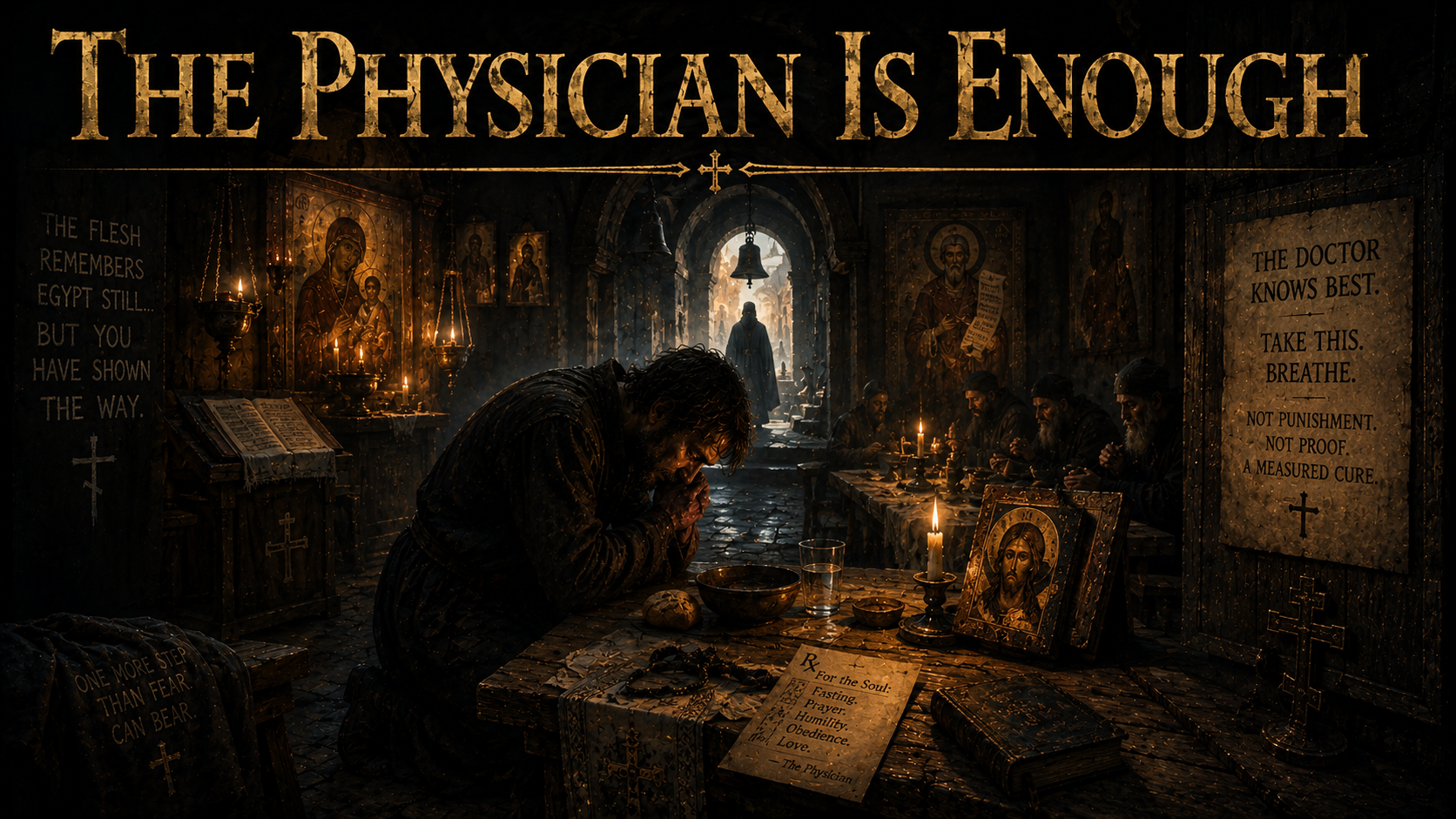
The Physician Is Enough: Humility Learned Through the Body
This song does something the album hasn’t quite done yet: it locates the theological work not in a moment of vision or recognition, but in the body’s slow, unglamorous argument with itself over days. And that’s exactly right for introducing humility as a theme, because humility in the Dostoevskian and Orthodox sense isn’t primarily an idea to be understood — it’s a posture the body has to be walked into, often against its own screaming protest. You’re right that this can’t read as a promotion of extended fasting, and the song is careful about that; what it actually dramatizes is something closer to an experiment that exposes a lie the narrator has been living under without knowing it.
The Courtroom Follows You Into the Hospital
“I came in with courtroom ink still on my thumbs” is a crucial admission, because it refuses the easy version of the previous track’s resolution. “Presence” ended with the machine broken, the briefs made irrelevant — but this song immediately shows that entering the hospital doesn’t erase the habits formed in the courtroom. “My chest cross-examines the ghosts in the room” and “the flesh takes the stand in the courthouse of skin” show the narrator’s whole interior vocabulary still organized around litigation, even inside a space no longer structured that way. This is honest to how Dostoevsky depicts change: it’s never instantaneous erasure. Raskolnikov’s epilogue conversion happens only after Dostoevsky has shown, over eight hundred pages, how thoroughly a mind can go on rehearsing its old arguments even in the presence of something that has already begun to dismantle them. Old courtroom logic doesn’t vacate the premises just because a verdict stopped being needed. It has to be slowly unlearned, one meal skipped, one craving outlasted.
Fasting as Diagnostic, Not Achievement
The song’s real insight — and this is where the humility theme actually lands — is in the pre-chorus’s day-by-day structure. “Day One— / I buy the lie. / Day Two— / the screaming cracks. / Day Three— / a ghost behind me. / Day Seven— / I have to beg myself to eat.” This isn’t fasting as spiritual accomplishment or willpower flexed. It’s fasting as evidence-gathering against a false testimony the body has been offering the narrator’s whole life: that its urgent demands are equivalent to truth. “The flesh remembers Egypt still” names this precisely — Israel’s wilderness generation, freed from actual slavery, immediately began longing to return to it, preferring the remembered fleshpots of bondage to the uncertain freedom of the desert. The body’s protest — “give me food or I die!” — turns out, verifiably, empirically, to have been lying the entire time. That’s a genuinely different kind of proof than anything in Act I. It’s not argued or intellectually dismantled; it’s simply outlasted, and in being outlasted, exposed.
This is close to something Dostoevsky’s Zosima teaches about the relationship between flesh and spirit — that the body’s passions constantly present themselves as necessities, as matters of life and death, when they are in fact negotiable, even illusory in their urgency. “The body bears witness. / The passions twist its testimony” is a remarkably precise way to state this: the body isn’t lying maliciously, and its witness isn’t worthless — but its testimony passes through the distorting medium of passion before it reaches the mind, and what arrives as “I will die” is usually, on inspection, just “I am uncomfortable and do not wish to be.”
Humility as the Death of a Trusted Self
“I taste humility and the back of it is bitter, / because humility means the death of the self I trust” is the theological center of the song, and it names something that distinguishes humility from mere self-criticism (which the narrator has been fluent in since track one). Self-criticism, as Act I demonstrated repeatedly — in the Underground Man’s endless self-analysis, in the narrator’s own courtroom instincts — can be exhaustive and still leave the analyzing self fully in charge, fully trusted, fully in control of the verdict. True humility is different in kind: it requires relinquishing trust in the very self doing the assessing. This is why Zosima insists that humility, not asceticism for its own sake, is the substance of genuine spiritual progress — the discipline (fasting, prostration, silence) is only valuable insofar as it dismantles the self’s confidence in its own authority to judge, decide, and control. “Pride filed an appeal from inside my ribs, / wearing my skin, reciting my name” shows exactly how sneaky this can get — even the fast itself can become a courtroom exhibit, “a spiteful little proof,” evidence entered on the narrator’s own behalf, pride wearing humility’s clothing. This is a subtle and important admission: the discipline itself isn’t automatically pure. It can be practiced in a spirit of self-justification as easily as in a spirit of surrender, and the song is honest about having caught itself doing both.
“Now I’m the Defendant, the Judge, and the Mob”
This line is a striking compression of the album’s whole courtroom obsession, and it names something worth sitting with: a self-contained trial, with no outside party at all, is not accountability — it’s theater. Raskolnikov’s private moral tribunal before his confession operates exactly this way; he is prosecutor, defense, and jury all at once, and the verdict he keeps producing is never stable precisely because a court with only one occupant cannot actually adjudicate anything. It can only oscillate. “The verdict I wanted is ash in my mouth. / So I lay myself down on the stone, / and stop defending” is the moment the trial finally ends — not through a favorable ruling, but through the narrator’s refusal to keep occupying every role in a proceeding that was never going to produce peace no matter how it concluded.
A Peace That Interrupts the Right to Be in Charge
“Not a peace I manufactured, / but a peace that interrupts my right to be in charge” is theologically exact, and it’s the clearest statement in the song of what distinguishes Orthodox humility from mere self-help discipline. This isn’t the narrator achieving calm through successful willpower — it’s peace arriving as an intrusion on the very sovereignty he’s spent the whole album exercising over his own case, his own verdicts, his own arguments. This is close to the structure of grace throughout Dostoevsky’s fiction: it rarely arrives as a reward for sufficient effort. It arrives as an interruption of the self’s presumed jurisdiction over its own outcome, which is exactly why it so often requires the self’s authority to be exhausted or surrendered first, rather than reinforced.
The Physician as Authority Beyond Argument
“The Doctor says I will not die of hunger. / The body does not believe the Doctor. / But I am learning” is a lovely small moment of honesty, because it doesn’t claim the narrator’s body has been convinced — only that trust in the Physician’s word is being chosen over the body’s testimony, even while the body keeps disagreeing. This tracks something important about the nature of faith in Dostoevsky’s world: it’s rarely depicted as the resolution of doubt, more often as fidelity maintained in doubt’s continued presence. Ivan’s faith crisis is never intellectually resolved in the novel — Alyosha doesn’t out-argue him. What Zosima and Alyosha model instead is obedience and trust practiced without waiting for every internal objection to fall silent first.
Closing: Obedience, Not Control
“The cure is not my control. / The cure is my obedience” is a fitting final statement for a song introducing humility, because it draws the precise distinction the whole album has been circling since “Smoke Without Fire”: mastery, discipline, and even fasting itself can all be practiced as forms of control — ways of managing outcomes, proving worth, filing a stronger brief. What this song proposes instead is fasting as obedience without ownership of the results — sitting “at the long table, / and eat what I’m given” rather than what’s demanded, decided, or earned. That’s a genuinely different posture than anything Act I’s narrator was capable of, and it sets up “Forgiveness Sunday” well: having practiced surrendering authority over his own body’s testimony, the narrator is now positioned to surrender authority over something even harder to release — the verdict he holds against others, and perhaps against himself.
Leave a Reply