
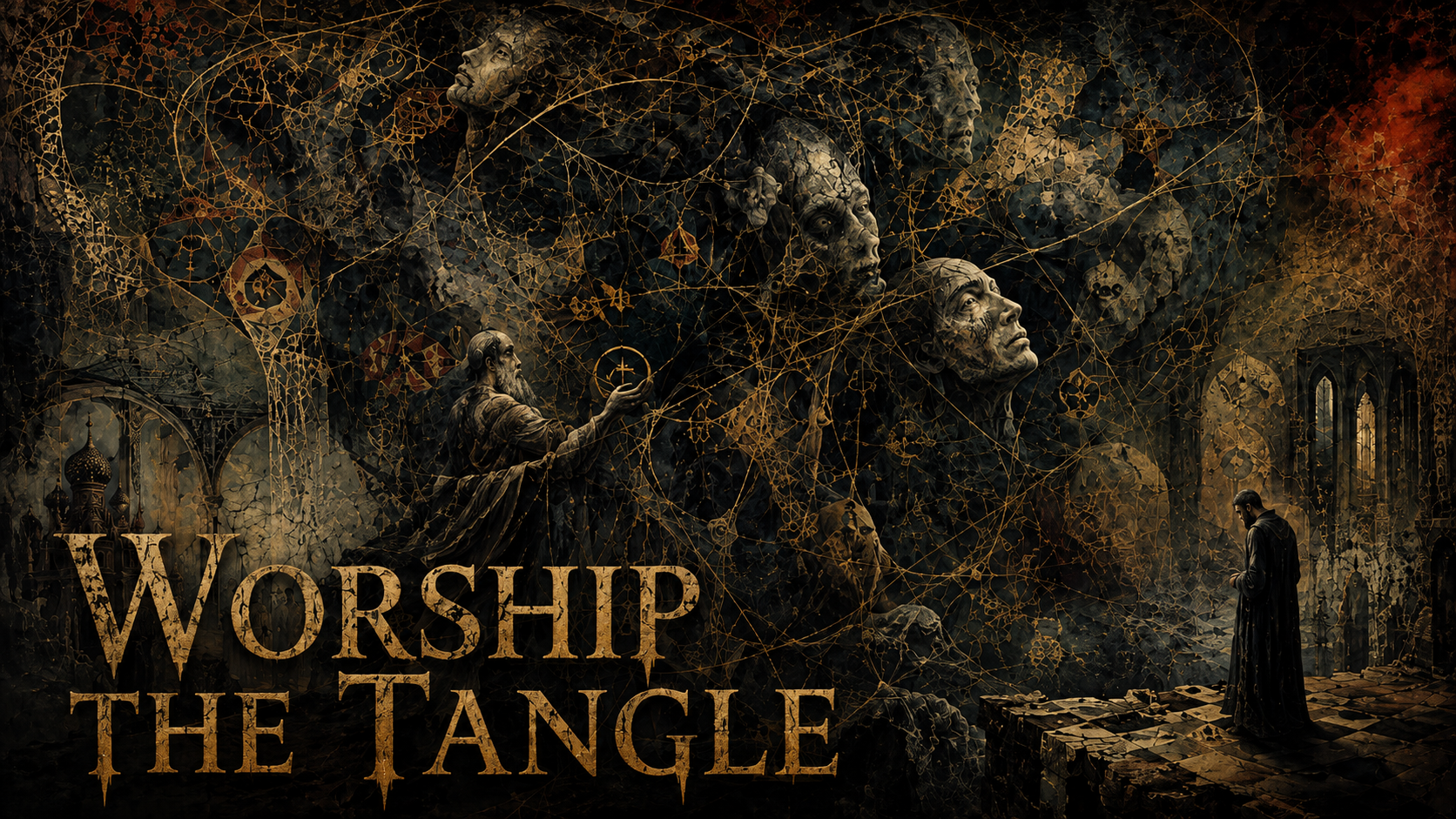
Worship the Tangle: The Knot We Keep Retying
This track earns its place right after “Elephants in the Forum” because it takes the diagnosis of that song — certainty as a self-made cage — and moves it from the battlefield into the sanctuary, from armies into individual souls. And the title itself is doing the real work here: worship. Not “we’re stuck in the tangle” or “we suffer under the tangle” — we worship it. That’s a precise and devastating word choice, because it names the tangle as an object of devotion rather than merely an obstacle, and that reframing is exactly where the Dostoevskian material gets interesting.
The Legend as Law: Inherited Certainty
“Every tale was gospel, every whisper law” establishes the psychological terrain before the knot even appears. What’s being examined isn’t the knot itself but the prophecy about the knot — the inherited interpretive frame that says only one specific act, performed one specific way, can grant what’s being sought. This is the precise structure the Underground Man rails against in his opening diatribe: not reason itself, but reason’s demand to be the only legitimate path, the single strand that must be traced correctly or the whole promise is forfeit. He calls the rationalists’ confidence a “stone wall,” and what he hates about it isn’t that it’s wrong so much as that it forecloses everything else — it says this and only this leads anywhere at all.
The pilgrims in verse one aren’t fools. “They pulled at the rope, they studied every strand, / measured every loop with furrowed, weary brows” — this is diligence, not laziness. That’s the crucial and uncomfortable point the song is making: the knot doesn’t survive because people are careless with it. It survives because people are faithful to it. “Leaving it untouched, still faithful to their vows” — faithfulness itself becomes the mechanism of bondage when it’s aimed at the method rather than the goal. This is close to something Dostoevsky returns to constantly: that piety and bondage can wear identical clothes, and the only way to tell them apart is to ask what the devotion is actually for.
The Grand Inquisitor’s Bargain, Inverted
The Grand Inquisitor’s whole argument to Christ is that humanity cannot bear the terror of open, undetermined freedom — that people need “miracle, mystery, and authority” to relieve them of having to choose without a guarantee. He frames this as mercy. Dostoevsky frames it as the deepest treason against what Christ actually offered. This song is staging a version of that same choice, but from the other side of the transaction: not a ruler imposing certainty on the crowd, but the crowd manufacturing certainty for itself and then bowing to its own manufacture. “The knot survives because we agree to its terms” — repeated as the hinge of the bridge and again near the end — is the Inquisitor’s logic turned inward and self-administered. Nobody chained these pilgrims. They chained themselves, and then knelt to the chain as though it were the god they came to find.
That’s the real twist in choosing the Gordian Knot as the vehicle here, and it’s a sharp one: the legend already contains, buried inside its own premise, the very trap Dostoevsky diagnoses in every rigid system his characters build for themselves. The prophecy promises that solving the knot correctly grants rule over the world. But “correctly” was never defined by anything except the accumulated weight of everyone who’d already failed and called their failure reverence. Verse three’s line lands hardest here: “I walked the same circles just to say I tried, / called it perseverance while I hid inside.” That’s the Underground Man’s whole confession in miniature — endless, elaborate self-justifying motion mistaken for integrity, when it’s actually a very sophisticated way of avoiding the one thing being asked.
Alexander as Anti-Type, Not Hero
You were right to say this isn’t really about Alexander’s cleverness, and the song bears that out structurally — he gets remarkably little space, and what he does get strips away any triumphalism. “He smiled at their wisdom, their courteous despair” is almost pitying. He’s not solving a puzzle they couldn’t solve; he’s refusing a category they’d all silently agreed to accept as real. “Centuries of habit hung heavy in the air” — the obstacle was never intellectual difficulty, it was accumulated consensus mistaken for immovable law. This maps onto how Dostoevsky depicts genuine spiritual freedom in figures like Zosima or Alyosha: they aren’t smarter than the systems around them, they simply refuse to grant those systems the ontological weight everyone else has agreed to grant them. Sonya doesn’t out-argue Raskolnikov’s theory of the extraordinary man. She makes it irrelevant by kneeling in the dirt and loving him anyway — a category the theory never accounted for because the theory, like the knot, only survives among people who agree to its terms.
“The Prison Was Never the Rope But the Mind”
This line is the theological center of the song, and it’s worth sitting with because it resists an easy misreading. It isn’t saying external structure is meaningless or that discipline is a lie. It’s locating the site of bondage correctly: not in the rope’s physical fact but in the mind’s relationship to it — whether the structure is inhabited as a living channel toward something real, or worshipped as an end in itself, mistaken for the very thing it was only ever meant to serve. This is precisely the distinction Zosima draws between “active love,” which is alive, costly, and adaptive to the actual person in front of you, and religious performance that has calcified into its own object of devotion. A method that once served genuine encounter can, unexamined, become a wall standing in for the very presence it was built to reach. The song never says which specific method — and it shouldn’t, and doesn’t need to, because the pattern it’s describing is portable. Every soul has some cart it has decided must be untied exactly one sanctioned way before it’s allowed to move.
Steel Where Fingers Cannot Go
“Steel found a passage where fingers could not— / when the pattern grows tight and the thinking does not” is a striking image because the blade isn’t violence against the sacred; it’s honesty about what the sacred actually required all along. This echoes something crucial in Dostoevsky’s account of confession and conversion: the moment of breakthrough is rarely gentle, rarely a reward for sufficiently patient effort. Raskolnikov doesn’t earn his confession through incrementally improved reasoning — something has to cut, has to sever what all his careful strand-counting couldn’t touch. Grace, again, arrives more like a blade than like a solution.
The Final Turn: “Just… Air”
The ending refuses catharsis in favor of something quieter and, I think, more honest: not walls broken down triumphantly, but walls that were never load-bearing in the first place. “Not broken. Not fallen. / Just… air.” This is a remarkably restrained way to close a song about liberation, and it’s the right choice for an album interested in the difference between certainty collapsing violently (as in “Elephants in the Forum”) and certainty simply being seen through — recognized as having no substance the moment devotion is withdrawn from it. That’s a subtler and in some ways more unsettling form of freedom, because it means the tangle was never actually powerful. It was only ever as strong as the worship aimed at it.
This sets up “Tangle & Icon” beautifully as a promised return, because this track deliberately leaves something unresolved: cutting the knot dissolves the false prophecy, but it doesn’t yet say what a living relationship to structure, discipline, or form ought to look like once worship has been correctly redirected. That’s presumably the work Act II’s title — Presence — exists to do: not the absence of all knots, all form, all discipline, but the difference between a structure inhabited as a means of encounter and a structure worshipped as a substitute for one.
Leave a Reply