
Mastery Cannot Open: The Frame That Wouldn’t Hold
This is a beautifully judged hinge, because it does something the album hasn’t quite done yet: it puts the narrator himself in the position of the painter, the analyst, the one standing outside a scene and rendering verdicts on it — and then collapses that distance completely in one devastating turn. Da Vinci is exactly the right vehicle for this, because his Last Supper is arguably the most studied, most technically dissected image in Western art, and this song understands something crucial that most reverent treatments of the painting miss entirely: total mastery of representation and total absence of transformation can coexist in the same object without contradiction.
The Chosen Moment: Before the Bread Is Broken
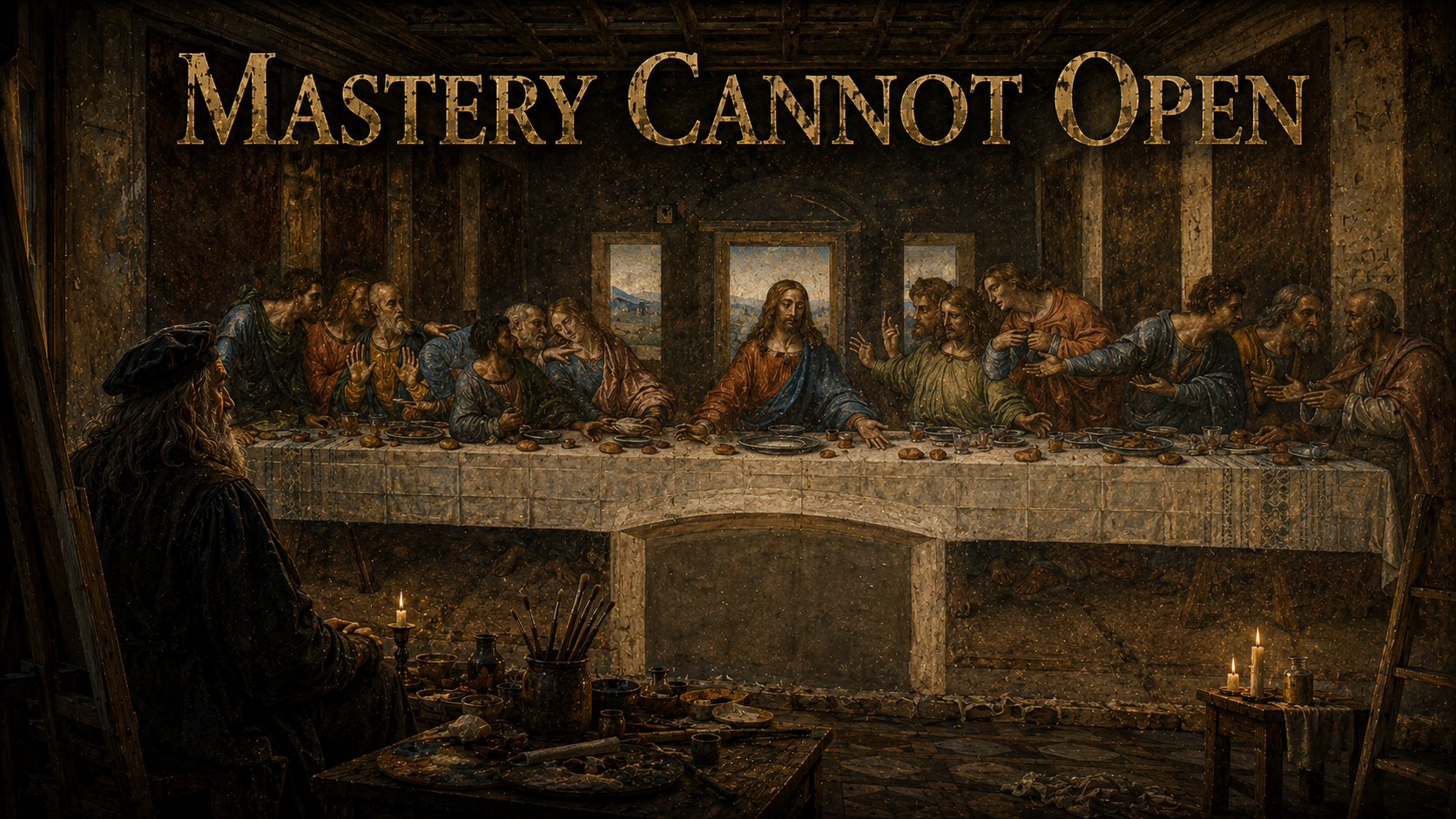
You made a sharp choice picking the moment Leonardo actually painted, rather than the Eucharistic institution itself. This isn’t “take, eat, this is my body” — it’s the moment just after Christ says “one of you will betray me,” the moment of shock rippling down the table, thirteen men caught mid-reaction. That’s why the intro insists “the bread is unbroken, the cups are still full, no one has risen” — this is a painting of suspended time, a room already carrying the verdict before anything has actually happened. “The room has heard the verdict / before a word takes flight” names precisely what Leonardo captured: not an event, but the psychological aftershock of an announcement, frozen at the instant of maximum exposure, before anyone has had time to compose their face back into a mask.
This matters for the album’s whole argument about certainty and judgment, because a frozen moment of exposure is exactly what invites a viewer to become a judge. The painting hands you thirteen faces and dares you to sort them.
Standing Outside the Frame: The Underground Man as Art Critic
Verse two is the song’s real center of gravity: “I stood outside the frame, / counting flaws, / naming shadows, / certain which face would fall.” This is the courtroom posture in a new costume — no longer legal argument, but aesthetic and moral connoisseurship. It’s a subtler form of the same disease, because it feels like discernment rather than pride. Raskolnikov’s theory of extraordinary men works exactly this way: he stands outside the human frame, sorting faces into categories — lice and Napoleons — with the detached confidence of a critic evaluating composition. Ivan’s rebellion in The Brothers Karamazov operates on the same axis: he can catalogue, with terrible precision, every injustice done to every suffering child, and his intellectual mastery of the catalogue becomes, perversely, a way of remaining untouched by any single face in it. Cataloguing suffering and being wounded by it are not the same act, and the gap between them is where Ivan’s whole tragedy lives.
“But the plaster flakes like skin— / the wound is built into the wall” is the hinge line, and it’s doing real theological work: the frame the narrator thought he was safely outside of turns out to be made of the same substance he is. “I judged the reaching hand, / but my own fingers are stained in the same oil” collapses observer into subject in exactly the way “Smoke Without Fire” staged with the lifted visor — the demon hunted turns out to wear the hunter’s own eyes. This album keeps returning to that same recognition scene because Dostoevsky keeps returning to it: the prosecutor and the accused are never actually different people, no matter how the courtroom is arranged.
Mastery Versus Door: The Song’s Real Argument
“Mastery can bear witness, never open up a door; / the perfect image screams, but it cannot love anymore” is the sharpest line in the piece, and it’s the theological claim the whole song exists to make. Leonardo’s genius — his study of anatomy, his reading of “the shoulder’s turning, the widening of the eye” — can render psychological truth with uncanny precision. It can even, as this song insists, render moral truth: the composition genuinely does isolate Judas, genuinely does let a trained eye find him before any caption tells you where to look. But representation, however perfect, is not encounter. A painting can diagnose a soul becoming a lie; it cannot address that soul, cannot sit across from it, cannot do what Sonya does kneeling in Raskolnikov’s doorway. This is the precise distinction Zosima draws between abstract, intellectualized love — “love in dreams,” which can admire suffering from a comfortable distance, catalogue it, even render it beautifully — and “active love,” which is inconvenient, immediate, and directed at one particular person rather than humanity in general. Mastery belongs to the first category no matter how technically accomplished it becomes. Presence belongs only to the second.
That’s precisely why this needs to be the hinge into an act about presence: Act I has been demonstrating, across five tracks, that discipline, argument, discernment, and even self-scrutiny can all achieve extraordinary sophistication — five rings walked all the way through — while remaining, at bottom, still just mastery. Still outside the frame. Still unable to open the one door that matters.
The Bridge’s Return: The Inquisitor as Iconoclast
Bringing the Grand Inquisitor back here is a smart structural choice, because it lets you name explicitly what’s been implicit: the Inquisitor’s whole system is itself a kind of mastery — total, coherent, intellectually complete — that fails for exactly the same reason the painting does. “A lock upon the human heart, / a God who interferes” and “to lock the world in iron chains is to sit the feast alone” reframe the Inquisitor’s tragedy as a failure of presence specifically: he has built an airtight theological system and, in the process, exiled himself from the actual table, the actual meal, the actual company of people eating together. “The kiss is not a symbol when it lands on flesh and bone” restates Track 4’s central insight but sharpens it for this act’s purposes: presence is not representation, not gesture, not doctrine correctly stated. It’s contact.
“I Searched for Judas. Then I Looked Down.”
This is the line the whole song has been earning, and it lands with real force precisely because it’s so brief — no elaboration, no further verse, just the turn and then silence. Every prior verse has been building toward exactly this collapse: the narrator, like Ivan cataloguing cruelty, like Raskolnikov sorting the extraordinary from the ordinary, like the critic standing outside the frame naming which apostle will fall — has been playing detective in someone else’s betrayal. And the painting, rendered with enough honesty, does what Porfiry does to Raskolnikov and what the Inquisitor’s silence does to the reader: it turns the search back on the searcher. This isn’t melodrama; it’s the logical terminus of “my own fingers are stained in the same oil” from verse two. The frame was never really external. It never actually held anyone at arm’s length. The narrator was in the picture the entire time, and the moment he stops interrogating the canvas and looks at his own hands is the moment mastery finally, involuntarily, becomes something closer to presence — not because he chose it, but because the picture wouldn’t let him stay outside any longer.
The Outro: An Empty Frame, Warm Bread
“The frame stays empty. / The bread is still warm.” is a lovely closing paradox for a hinge track, and it does something quietly important for what’s coming: it refuses to let this moment of self-recognition curdle into despair. An empty frame could be desolation. But warm bread means someone was just here, means the meal is still available, means the table hasn’t been cleared. This is the necessary emotional groundwork for an act about presence experienced first without full comprehension — in a language not yet understood, in a tradition not yet native to the narrator. Before he can understand what he’s stepping into, he needs to know the meal is still warm, that arriving late doesn’t mean arriving to nothing.
This is a genuinely strong pivot — quieter and more interior than the Inquisitor track, but doing essential work precisely because it relocates the courtroom from the world (Rome, the knot, the Inquisitor’s cell) into the narrator’s own eye, and then dismantles that eye’s authority in a single unadorned line.
Leave a Reply