
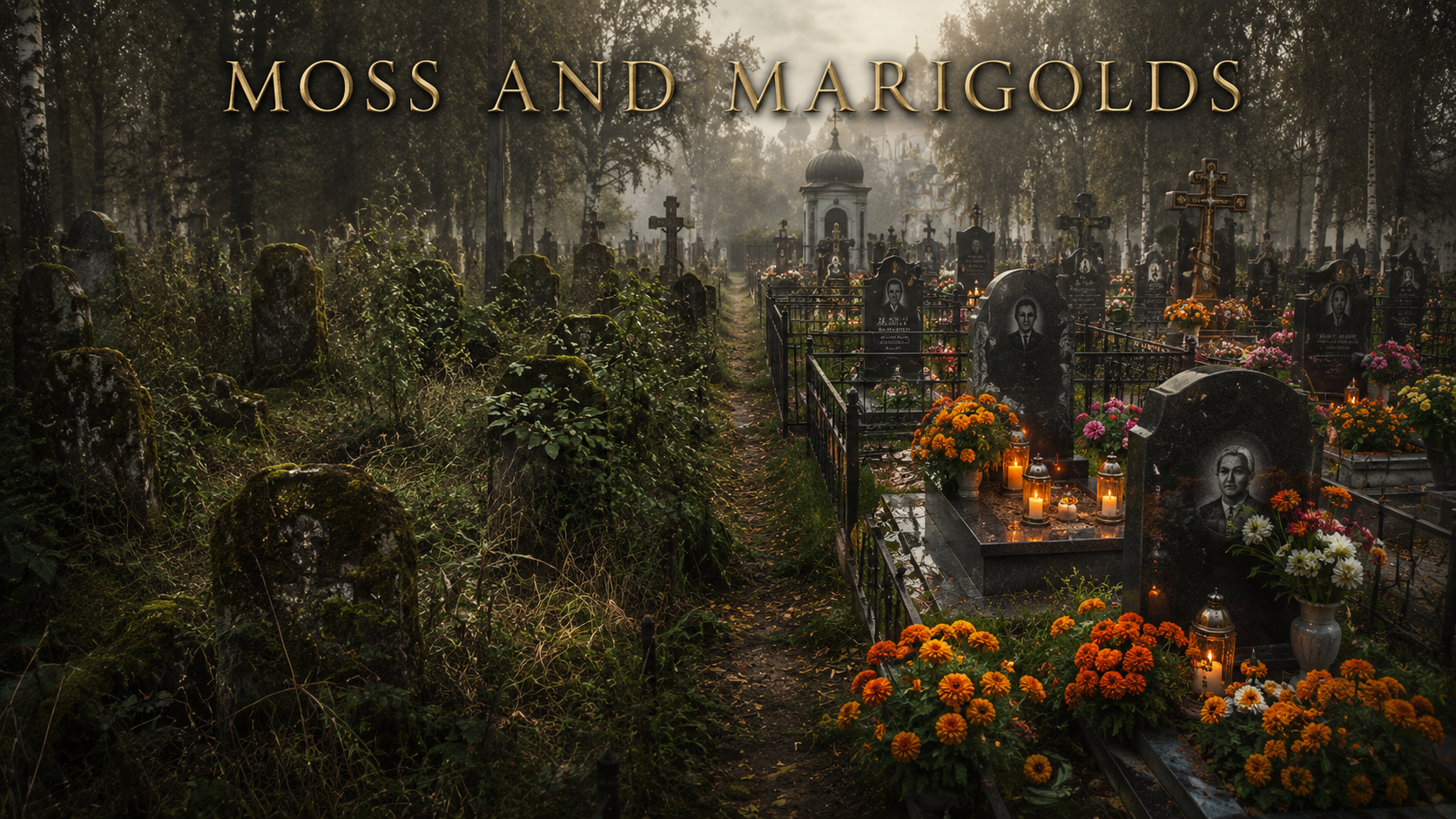
Moss & Marigolds: A Song for the Unvisited
A review
There’s a particular kind of grief that has no mourner left to carry it — the grief of a grave nobody tends anymore. “Moss & Marigolds,” written in the wake of a visit to a family cemetery in Kostakovichy, Belarus, takes that grief and turns it into a vocation. This isn’t a song about death. It’s a song about witness — about what it costs, and what it means, to be the one who still remembers when no one else does.
The Image at the Center
The song opens with a simple, devastating observation: a cemetery split in two. “Where some stand bright with flowers, / And others stand alone.” That’s the whole song in miniature — one image doing the work that could easily have taken a page of exposition. Moss on the oldest dates, rain darkening the gates: the physical decay of the marker becomes a stand-in for the erosion of memory itself. You don’t need to know a single name in that graveyard to feel the weight of “No hands return to tend them now, / No voice calls out their names.”
What’s striking is the restraint. The pre-chorus could have tipped into sentimentality, but it holds its shape with a plain, almost liturgical directness — “The earth keeps all its secrets close, / So I carry what remains” — which sets up the chorus not as an emotional release but as a task. Lay flowers. Light a candle. Speak the name. It reads less like a chorus and more like a set of instructions for what to do with grief that isn’t yours but that you’ve chosen to carry anyway.
Verse Two: Inventory as Elegy
The second verse is the strongest writing in the song. Instead of continuing the wide-lens meditation of verse one, it drops into close-up: a faded uniform, a wedding ring, a child’s first tooth, a lullaby. It’s an inventory, almost forensic in its specificity, and that’s exactly why it lands. Grief theorists talk about how the object outlives the person — the ring stays, the hand that wore it doesn’t. This verse understands that instinctively. “Fathers with calloused hands / Mothers with sleepless eyes” gives you an entire unwritten biography in eight syllables. This is where the song stops being about a cemetery and starts being about the people who happen to be under it.
The Bridge and the Turn Toward Transcendence
The bridge is where the song reveals its theological hand. “I stand here as their witness, / I speak what time forgot” is the emotional thesis — but the real pivot comes in the quieter passage after: “We are not lost to heaven, / We are not lost to prayer — / The saints lean down to hear us, / And the living still can care.” This is a song that believes memory is not just sentiment but intercession — that speaking a forgotten name is itself a kind of prayer, and that there’s a communion between the living and the dead that neglect can’t fully sever. It’s a very old idea, older than any one graveyard, and it gives the song a backbone that a purely secular elegy wouldn’t have. The forgotten aren’t simply gone; they’re waiting to be spoken for.
The Outro: Where the Song Actually Lives
The final image — “Moss and marigolds / On stone and rusted wire” — is the title pulled back down to earth after the bridge’s height, and it’s the right choice. Rusted wire is such a specific, unglamorous detail; it keeps the song from floating off into abstraction. Then the closing line does something few songs manage: it flips the narrator from witness to subject. “If you pass through here tomorrow — / would you remember me today?” The dead stop being the ones asking to be remembered and become, suddenly, a mirror. Every listener becomes, for a second, the neglected grave. That’s a hard trick to land without being heavy-handed, and it works here because the whole song has earned it — you’ve spent four minutes learning to care about strangers’ graves, so the pivot to “you, too, will be a name someone has to choose to speak” doesn’t feel like a lecture. It feels inevitable.
The Verdict
“Moss & Marigolds” belongs to a small, worthy tradition of songs that treat memory as a moral act rather than a passive feeling — you don’t just feel sad about the untended graves, you’re asked to do something, even if the something is as small as saying a name out loud. Written, by all accounts, in the space of a car ride home from the cemetery itself, it has the immediacy of something caught before it could be over-thought, and it’s better for it. The overgrown half of that graveyard gave you a real, specific wound to write from — and the song does the rare thing of making a private grief feel like a shared obligation.
Lay flowers on the graves. Light a candle low. This one asks you to mean it.
Leave a Reply