
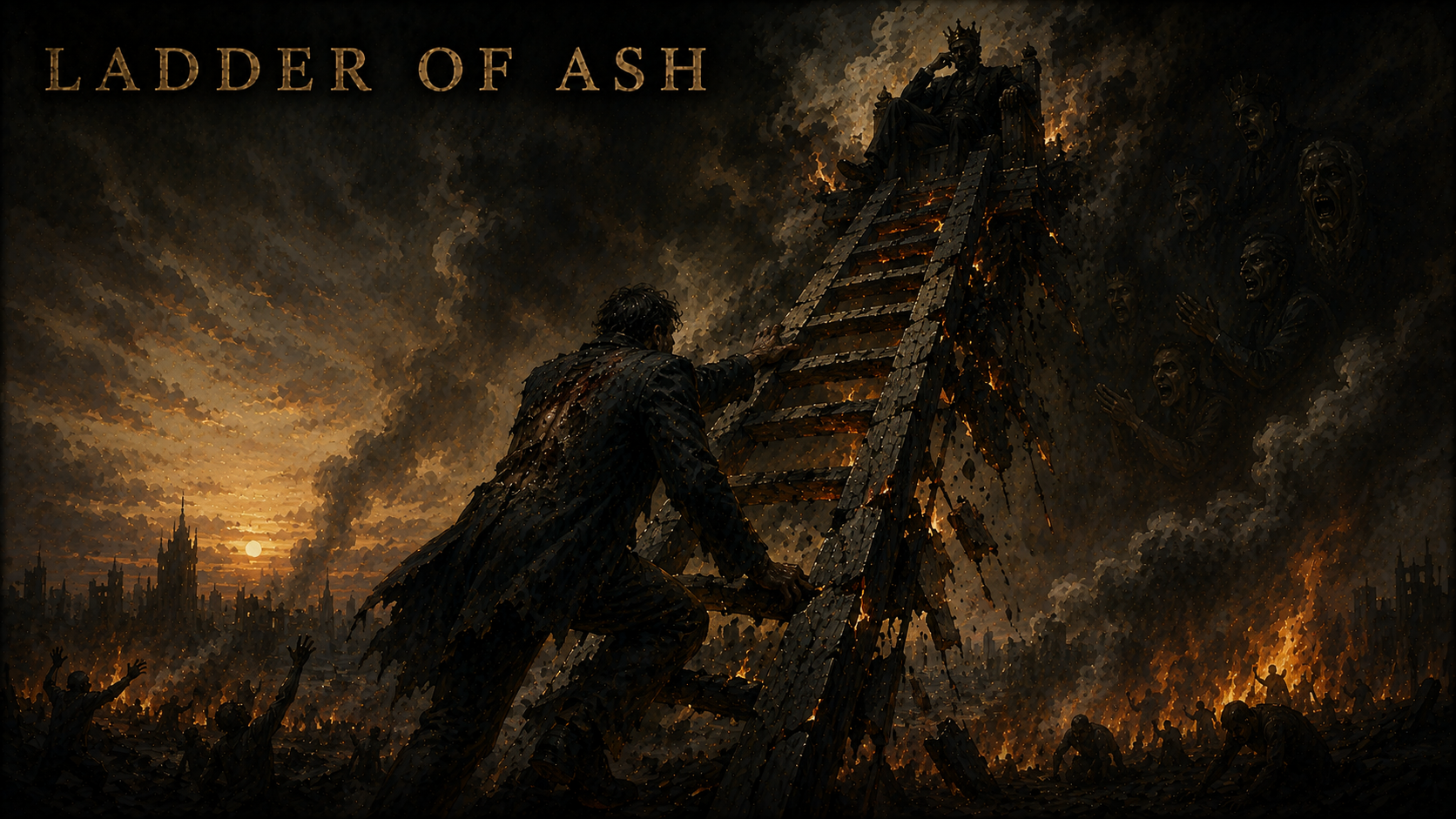
The Fire That Becomes Its Own King: Dostoevsky, the Self-Made Throne, and the Inevitability of Ash in Ladder of Ash
Introduction
Dostoevsky had a specific term for the person who constructs their ascent from the wreckage of others: he did not call them villains. He called them men who had lost the capacity for genuine human contact, who had replaced the warmth of actual relationship with the heat of their own ambition, who had climbed high enough that the faces below them had ceased to be faces and become, simply, rungs. He understood this type not as an aberration but as the logical endpoint of a particular philosophy — the philosophy that places the self above the common moral order, that permits the extraordinary individual to use ordinary people as materials.
Raskolnikov theorizes this philosophy before he commits his crime. The Grand Inquisitor administers it from his palace. Fyodor Pavlovich Karamazov practices it without the philosophical scaffolding, through pure appetite. And what Dostoevsky shows, in each case, with the patience of a novelist who knows how physics works, is the same thing: the ladder made of smoke and shattered dreams and broken pledges and the bones of whoever got in the way does not eventually carry its builder to the summit. It carries them, inevitably and structurally, to the ash.
Ladder of Ash is the album’s most formally compressed song, and the one you describe as “light” — written on a day of relief from heavier thinking. What that relief produced is a parable: tight, almost balladic in its economy, with the formal momentum of a story that knows exactly where it’s going and moves there without unnecessary stops. The lightness is not absence of weight. It is the weight delivered at speed.
I. The Forged Rungs: Building on the Wrong Materials
The opening verse establishes the construction project and its materials with the concentrated imagery of a poet who knows they have eight lines to set up everything that follows:
He forged his rungs from smoke, / A throne from shattered dreams, / Stacked broken pledges high / On bones and silent screams.
“Forged his rungs from smoke” — the first material is smoke, which has run through this entire album as the residue of what burns: the houses of Accident of Trust, the walls of King Without a Crown, the certainties of Icons in the Smoke, the genealogy of falsehoods of Never Ask the Liar. To forge rungs from smoke is to build a structure from the aftermath of what has already been consumed — to use destruction as raw material rather than acknowledging it as loss. The rungs feel solid because they have been forged, because effort has been applied to them, because they have the shape of a tool. But their substance is smoke.
“Stacked broken pledges high / On bones and silent screams” — the catalog of materials is precise and deliberately varied: smoke (the insubstantial), shattered dreams (the aspirational reduced to wreckage), broken pledges (the relational destroyed for advantage), bones and silent screams (the human cost rendered invisible). The “silent” screams are the most important detail. The builder of this ladder has not even had to hear the cost. The screams were silenced — by distance, by power, by the simple fact that the person ascending does not look down, and the sounds from below do not travel that far up.
This is Dostoevsky’s understanding of the Napoleonic type — the man who believes himself licensed to cross certain lines because of what he believes himself to be. Raskolnikov’s theory explicitly accounts for the screams: they are the necessary cost of the extraordinary man’s progress, regrettable in the way that a general regrets battlefield casualties, not in the way that a human being regrets having harmed another human being. The theory is a way of not hearing the screams. The ladder is built in the silence the theory provides.
He laughed at peace like rain / On rusted iron— / Then fed the dark each dawn / And called it mine.
“Laughed at peace like rain on rusted iron” — peace, here, is corrosive rather than restorative: it would rust the iron of the ambition, would slow the mechanism of the climb. The builder does not want peace. Peace is the enemy of the ascent. This is the Underground Man’s relationship to the Crystal Palace utopia — he hates it not because it is wrong but because it would require him to stop, to settle, to accept a condition in which his particular energies have no more ladder to climb.
“Fed the dark each dawn and called it mine” — the most quietly devastating line in the verse. Every morning the builder makes a choice: to feed the dark, to add fuel to the mechanism of the ascent, to take from whatever or whoever is available and add it to the structure. And then they call it ownership. They call it mine. The claiming of the dark-fed thing as personal achievement is the final step in the self-deception: not only building on smoke and bones, but believing the structure belongs to them rather than to the materials they consumed to build it.
II. The Pre-Chorus: The Physics of the Chosen System
But every spark has teeth, / And every liar learns—
Two lines, and then the chorus interrupts what the liar will learn, as if the learning itself is the chorus’s business to demonstrate rather than the pre-chorus’s business to explain. This is formally exact: the pre-chorus tells you there is a consequence, and refuses to deliver it, because the consequence is better shown than described. The “but” here is not the half-confessor’s “but” of But… — it is the structural “but” of the physical universe, the “but” of cause and effect, the “but” that Newton would have used. You built it this way, but — and then the chorus demonstrates the outcome.
“Every spark has teeth” — the spark from Spark to Abyss, from Shattered Reverb, from Tarred by My Own Hand, from every fire this album has set and watched consume what it kissed. The spark is not passive. It is hungry. It has its own direction and its own momentum, and what it feeds on is not what its maker intended but what it can reach — which eventually, inevitably, includes the maker.
III. The Chorus: The Mechanism of Structural Consequence
Climb the ladder, feel it crack, / Rungs snap sharp against your back. / Higher up, the lashes sting, / The fire you made will be your king.
You thought you ruled the flood, / Now drown in what you trust. / Build it high. Watch it turn. / Watch it all return to ash.
“The rungs snap sharp against your back” — the rungs do not merely break beneath the feet of the climber. They snap against the back. The structure that was climbed becomes the structure that strikes. This is the physics of the self-made system: it does not simply fail — it turns, and in turning it applies to the builder exactly the force the builder applied to others in building it. The broken pledges become broken promises returned. The bones and silent screams become a noise that finally travels upward.
“The fire you made will be your king” — this is the line that earns the article it’s being given. The fire was made as a tool, a mechanism of power, the energy that drove the ascent. The fire has become a sovereign. What was deployed as instrument has become master. This is the structural consequence that Dostoevsky diagnosed across every iteration of the extraordinary-man theory: the theory that licenses the use of others as tools does not remain a tool of the person who holds it. It becomes the thing that defines them, owns them, determines their choices, rules the kingdom they thought they were building for themselves.
Raskolnikov does not use his theory. His theory uses him. It produces the murder; it produces the fever; it produces the isolation; it produces the inability to receive any human warmth because the theory has defined warmth as irrelevant to the extraordinary man. The fire he made became his king long before he knew it had crowned itself.
“You thought you ruled the flood / Now drown in what you trust” — the flood is another element of the self-made system that has exceeded its maker’s control. The builder trusted the structure — trusted the smoke-rungs, the broken-pledge foundations, the bones-and-screams materials — and this trust, this confidence in the engineered ascent, is the medium of the drowning. The flood does not surprise them from outside. They drown in what they built, in what they trusted, in the structure that was always going to reach this point because it was built from materials that could not hold.
“Build it high. Watch it turn. Watch it all return to ash.” — the imperative “build it high” is not encouragement. It is the tone of someone who has watched this before, who knows the sequence, who is simply reporting the physics: you want to build it high? Build it high. Here is what follows. The watching is not passive — it is the specific, calm observation of someone who understands the mechanism and knows that explaining it further would not help. The lesson is the sequence. The ash at the end is not punishment. It is the material revealing its nature.
IV. Verse 2 and the Second Pre-Chorus: The Tongue He’s Never Spoken
He split his vows in two / Just to hear their cheer. / Traded fear for friends, / Kept the market clear.
“Split his vows in two just to hear their cheer” — the social function of the builder’s manipulation: the vow is split not because it was believed but because the performance of the vow generates approval, and the approval is what was actually wanted. The cheering is the product; the vow is the raw material. This is Dostoevsky’s understanding of the narcissist’s relationship to loyalty: not as a genuine commitment but as a currency, exchanged for the validation that fuels the ascent.
“Stacking up his debts / In a tongue he’s never spoken” — this is the most oblique and most interesting line in the verse. The debts accumulate in a language the builder cannot read — a language of genuine obligation, of actual relationship, of the weight of what was owed to the people whose dreams were shattered and whose pledges were broken. He has been generating this debt in a tongue he’s never spoken because he’s never needed to speak it. He has always been in the position of the creditor. The debts are real but invisible to him, because their language is one he has never learned and, at this height, cannot even hear.
Now the axe he raised falls / From his own hand. / The storm that crowned him / Crowns him still— / But he’s forgotten how to feel it.
“He’s forgotten how to feel it” — this is the line that moves the song beyond simple morality tale into Dostoevskian tragedy. The narcissist of King Without a Crown could not feel the stethoscope, could not locate the wound, could not answer “where does it hurt?” because the fortress had been built too high and too thick for the question to penetrate. Here, the storm that crowned the builder in his ascent — the ambition, the power, the momentum of the climb — still crowns him at the top. But the feeling is gone. He has paid for the height with the capacity to experience anything at the height. The anesthesia is complete.
This is Dostoevsky’s most frightening diagnosis of the self-built man: not that he suffers at the summit, but that he cannot. The suffering would at least be evidence of something living inside the structure. The numbness is the revelation that what climbed the ladder is no longer what went in at the bottom.
V. The Bridge: The Shadows Wear Your Face
Hear the split, / The wooden laugh. / Shadows stand tall— / They wear your face now.
The blade you forged / Finally claims its name. / Every mouth it opens / Asks for yours.
“Shadows stand tall — they wear your face now” — the double returns, in the language of The Double in the Mirror, but in its most extreme form: the shadows are not the builder’s internal division. They are the external doubles generated by the system of ascent itself — the alliances made for strategic advantage, the agreements entered for mutual benefit, the network of people whose loyalty was purchased rather than earned. They wear the builder’s face because they were formed in the builder’s image, to serve the builder’s purpose. And now they are standing tall, independent, with the builder’s own methods at their disposal, their own ladders under construction.
“The blade you forged / Finally claims its name” — the weapon has become autonomous. It has developed the identity it was always moving toward — not the tool’s name but the instrument’s name, the thing that cuts and has always cut, and now cuts without the hand that made it. The blade’s name is not “my instrument.” It is the blade’s own name, the one it claims when it is finally no longer in the hand of the one who forged it.
“Every mouth it opens / Asks for yours” — the blade that has been opened in other people’s mouths has been asked a question with each opening, and the question was always the same: whose? Whose blade? Whose hand? Whose system is this? And the answer circles back, because the system was built by a specific person with a specific name, and the accounting eventually reaches that name. Every mouth the blade opened in the ascent now opens asking for the mouth that commanded it.
VI. The Final Chorus: Gods Fall Hard
Break the ladder, watch it crack, / Every rung snaps at your back. / The sky falls down, a burning lash— / The fire you made devours the last.
You thought you ruled the flood. / Now you’re drowning in what you trust. / Gods fall hard. The ladder turns to ash. / And you…
“Gods fall hard” — the shift from “you thought you ruled” to “gods fall hard” marks the song’s final reckoning. The builder thought they were exercising the power of someone who had earned the title through the ascent. The song corrects this: they thought they were a god. The ladder was a ladder to divinity — self-made, self-proclaimed, constructed from the materials of other people’s demolished lives. And gods — specifically the small gods, the self-made ones, the ones whose divinity was forged from smoke — fall the hardest, because the height was real even if the divinity was not.
The MENE MENE of King Without a Crown closes the circle here. Belshazzar was a king who used the sacred vessels for his own feast. He was weighed and found wanting. He fell hard. The ladder turns to ash not because God intervenes dramatically but because ash is what smoke-rungs become when they are no longer needed to sustain the illusion of solidity. The physics complete themselves.
“And you…” — the sentence left incomplete is the song’s most elegant gesture. The chorus has described the ash, the fall, the fire devouring the last. And then it arrives at the subject — “and you” — and stops. The completion of the sentence is left to whoever is climbing their own version of this ladder, in whatever materials they have chosen. The song will not complete it for them, because what “you” are at the bottom of that ash is a question only the individual confronting the ash can answer.
VII. The Outro: The First Brick Moves Again
So raise your tower high. / If you must.
The first brick moves. / The last turns to dust.
(long pause)
…and the first brick moves.
“If you must” — the song’s final ironic gift. After everything, the permission is extended. You want to build it? Build it. If you must. The “if you must” carries the weight of everything that precedes it — the smoke-rungs, the broken pledges, the bones, the blade, the ash — and extends it not as prohibition but as resigned acknowledgment. The song is not in the business of preventing the construction. It has simply described, with complete accuracy, what the construction produces.
“The first brick moves. / The last turns to dust.” — the arc of every self-built tower, compressed into two lines, with the physical inevitability of a law of nature rather than a moral judgment. Not “the last should turn to dust” or “the last will be punished by turning to dust.” Simply: the first moves, the last turns to dust. Between these two facts, everything the song has described takes place.
The long pause is structural necessity — it is the silence between the warning and the demonstration of what happens regardless of the warning.
“…and the first brick moves.”
The builder begins again. Of course they do. This is Dostoevsky’s deepest understanding of the compulsive self-builder: the destruction of the tower does not cure the building impulse. It satisfies it temporarily, clears the ground, and then — because the psychology that produced the first tower is unchanged — the first brick moves again. The Underground Man returns to his underground after every failed emergence. Raskolnikov returns to his theory even after his crime has proven its cost. The fire that made itself king will make itself king again if given another ladder to crown.
The hope — the slim, quiet, Dostoevskian hope — is that each time the first brick moves, it is possible for the mover to choose different materials. Not smoke. Not broken pledges. Not bones. Something that could bear weight without becoming ash. But the song does not offer this hope explicitly. It simply ends with the brick moving, which leaves the question of materials entirely to the person holding it.
VIII. The Album’s Summary in a Different Key
You described this song as the album’s summary, written in a lighter register on a day of relief — and this is precisely what it is, though perhaps not only because of the day. The summary function of Ladder of Ash is that it takes every theme the album has treated from the inside and renders it from the outside: the narcissism of King Without a Crown seen from the structural consequences; the self-deception of The Shared Room and Never Ask the Liar seen as building material; the fury of Tarred by My Own Hand seen as the axe that falls from the builder’s own hand; the infernal passion of Spark to Abyss seen as the fire that becomes king; the doubled self of The Double in the Mirror seen as the shadows that stand tall wearing your face.
The “lightness” is the altitude — the distance from which you observe the mechanism rather than inhabit it. From inside the ladder, every song on the album is heavy with the immediate experience of being the person climbing or the person being climbed on. From outside the ladder, watching it turn to ash, the observation is clean and almost serene. This is not indifference. It is the specific lightness of someone who has already been inside the mechanism and come out the other side into the dawn — the person who can now describe the physics because they have lived them, and who can describe them without the internal weight because the living is behind them rather than present.
This is why the song works as a summary: it describes what the album has spent twenty songs inhabiting, from the position the album has been trying to reach — the position outside the cage, in the language of Shattered Reverb, where the reverb can be heard as reverb rather than as music, where the ladder can be seen as a ladder to ash rather than as the only available structure.
Conclusion: The First Brick, the Last Dust, and the Question of Materials
Ladder of Ash ends where the album’s entire project began, and this is not accidental. The first brick moves — always, again, inescapably. The question the album as a whole has been asking, across every form of self-deception and every anatomy of wound and every approach to the hospital and every surrender of the pen, is not whether we build. We build. We forge our rungs from whatever is available. We climb. The question is what we use.
Smoke. Or something that can bear weight.
Broken pledges. Or kept ones.
Bones and silent screams. Or the willingness to hear the screams and still choose differently.
The first brick moves, as it always will. The ash awaits, as it always does, for the structure built from the wrong materials. The ladder built from the right ones — from Statues in the Daylight‘s genuine witness, from Icons in the Smoke‘s patient beauty, from The Unshielded Mouth‘s surrender of the pen, from Empty Chair at Dawn‘s bare gratitude for the returning dawn — does not turn to ash. It becomes, slowly, with enormous difficulty, and never completely within the span of any single narrative, something that can hold the weight of an actual life.
The first brick moves.
What it’s made of is the only question.
Leave a Reply