
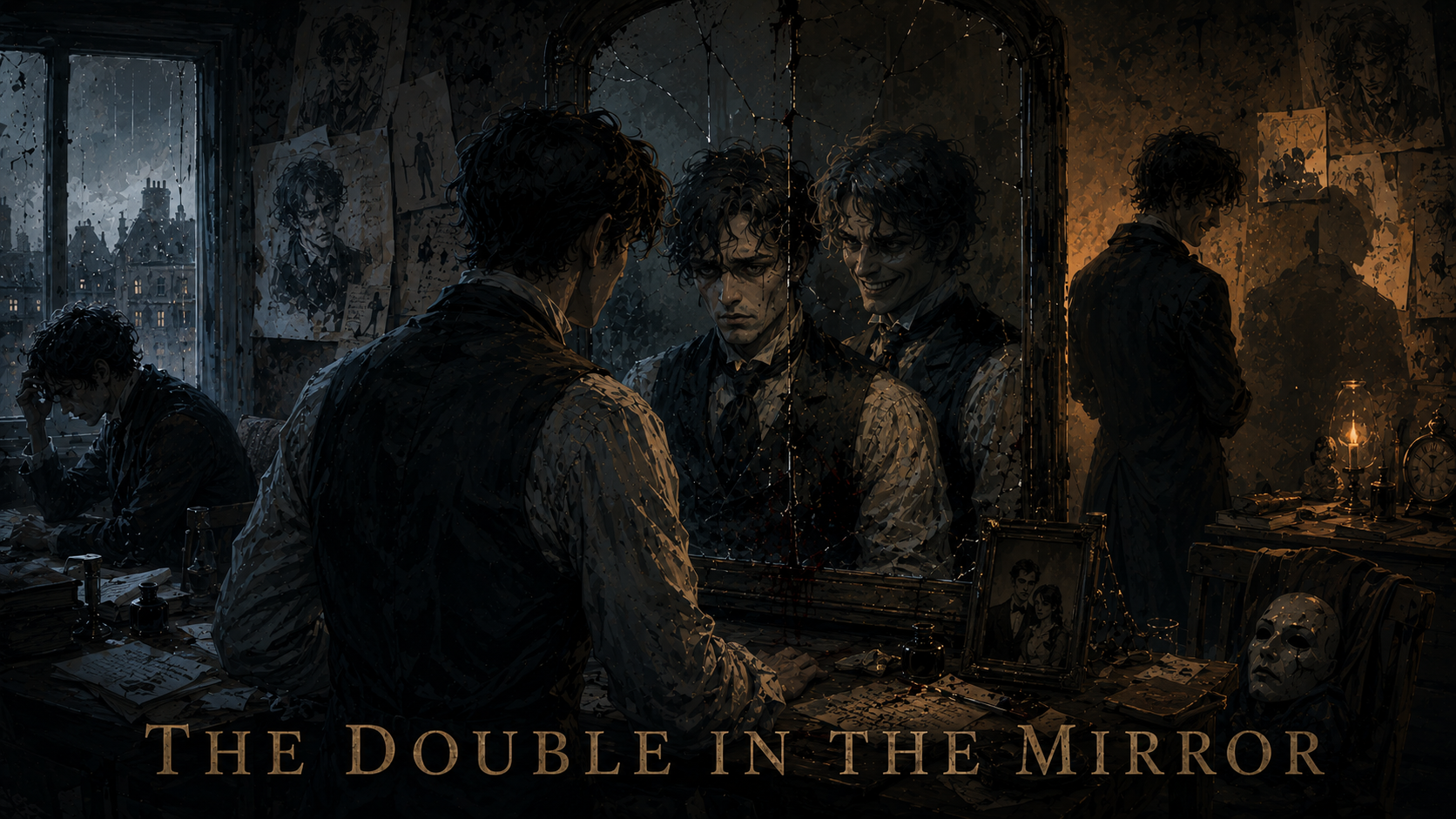
Two Men in One Grave: Dostoevsky’s The Double and the Ontology of the Split Self in The Double in the Mirror
Introduction
In 1846, a twenty-five-year-old Dostoevsky published his second work of fiction, a novella called The Double, and immediately declared it his most important piece of writing. The critical establishment disagreed — Belinsky, who had championed his debut, found it tedious and overwrought — and the work was largely dismissed for decades. Dostoevsky spent the rest of his life insisting they were wrong. In his notebooks, in his letters, in the authorial notes he appended to later editions, he kept returning to The Double as the key to everything he was trying to understand about the human interior: not the story of a man who hallucinates a rival, but the story of the self encountering its own repressed contents given independent form, walking through the world with its face, and doing everything it cannot do, including destroy it.
What Dostoevsky intuited in The Double — and developed across every major novel that followed — was that the self is not a unity. It is a negotiation, a temporary arrangement between competing impulses, desires, and self-images, most of which are in fundamental conflict with each other. The person who appears in public — the clerk, the husband, the lover, the friend — is a social construction built on top of, and in constant tension with, everything that could not be included in that construction. What gets excluded does not disappear. It persists, beneath the social self, looking for a way out, and eventually it appears — in dreams, in compulsions, in inexplicable eruptions of behavior the conscious self cannot account for. Or, in Golyadkin’s case, it walks out the door and begins filing papers at the next desk.
The Double in the Mirror is a song written from the interior of this experience, and it is the most directly Dostoevskian piece on the album in the sense that it takes its central premise — the split self, the doubled identity, the two men in one skin — directly from the novella and develops it through an intimate relationship, asking what happens when two doubled people attempt to love each other, and whether anything real can survive between four ghosts haunting the same room.
I. The Morning Mirror: Where the Double First Appears
The song begins, precisely where Dostoevsky begins, at the mirror:
I shaved this morning — he watched me stare / Dread pooled deep when his smile stayed bare / He leans in when I flinch, stands tall when I bend / While mouthing the words I rehearsed but never send
The shaving mirror is the primary locus of Golyadkin’s horror in The Double. The mirror is the place where the self is supposed to confirm itself — where the face one shows to the world is assembled, prepared, made presentable. It is the ritual of self-construction before the social day begins. And it is precisely at this moment — the moment of assembly, the moment of preparation — that the double appears, because the double is what the mirror actually shows when the social self is not yet fully in place, when the person is still in the process of deciding what face to put on.
“He leans in when I flinch, stands tall when I bend” — the double is not a passive reflection. He is a correction, an inversion, the other pole of every impulse the speaker suppresses. When the speaker retreats, the double advances. When the speaker submits, the double asserts. He is everything the speaker has decided not to be in order to be what they are, and he is more fluent in it. “Mouthing the words I rehearsed but never send” — the double speaks the rehearsed truths. He says the things the speaker has composed in the interior and then swallowed. He is the speaker without the self-censorship, and his existence is both envied and terrifying.
Golyadkin’s double in the novella begins exactly this way: at first he simply appears, wearing Golyadkin’s face, moving through Golyadkin’s world. Then he begins doing everything Golyadkin cannot — socializing effortlessly, charming superiors, succeeding at the tasks Golyadkin fails. The horror is not that the double is alien. The horror is that he is recognizable. He is the version of Golyadkin that Golyadkin might have been, doing with ease what Golyadkin has always wanted to do, and doing it with Golyadkin’s own face.
II. The Clerk Who Files the Lies: The Social Self as Administrative Function
The pre-chorus identifies the social self with one of the most specific and pointed images on the album:
I’m the clerk who files the lies / I’m the thief who nods and smiles
The clerk is not a random choice. In Dostoevsky’s fiction, the titular rank of Titular Councillor — the lowest rung of the Russian civil service, the rank Golyadkin holds — is the social designation of the person who has been entirely absorbed into bureaucratic function, whose identity has been subsumed by their role, who exists in the social world as an administrative unit rather than as a self. The clerk files things. He does not evaluate them, does not judge them, does not take moral responsibility for their content. He receives, he processes, he files. He is the perfect embodiment of the performed self that has no genuine content of its own — only the documents that pass through it.
“I file the lies” — the lies are not mine, exactly. I am merely the mechanism by which they are processed and stored. I receive the lie (something my social self has told, or that my social self has accepted from others), I process it through the appropriate channels, and I file it in the appropriate drawer. This is the Underground Man’s self-description of his own complicity in the social arrangements that trap him: he does not choose them, exactly, but he participates in their maintenance, and his participation is the form his unfreedom takes.
“The thief who nods and smiles” — the other face of the same double. The thief takes what is not his: attention, love, trust, intimacy — all extended to the social self, to the clerk, rather than to the real person beneath it. Every nod, every smile, every presentation of the assembled face in the morning mirror is a form of theft: it accepts the other person’s investment in someone who is not entirely real. The thief knows this. The smile is the tell.
III. The Chorus: The Fundamental Instability of the Doubled Self
The chorus of the song’s first iteration is a direct dramatization of the experience Dostoevsky spent his career mapping:
I am two men wearing the same face / One reaches for you, the other turns away / God, it tears me in half — which one am I today? / I built the bridge, then ripped the planks, and still I beg you stay
“Which one am I today?” — this is the question Golyadkin cannot answer, because the answer changes, because the two men are not stable entities with consistent positions but competing vectors within the same person, each dominant for a period before the other reasserts. The horror is not the existence of the two men but the absence of a third — a stable, unitary self that could decide between them, that could say this one, that could take responsibility for a consistent position.
“I built the bridge, then ripped the planks” — this is the pattern of the doubled person in relationship: the approach and the withdrawal, the intimacy constructed and then dismantled, the connection made and then sabotaged, not because the person does not want connection but because the part of them that does want it is in constant civil war with the part that fears it, resents it, cannot tolerate the vulnerability it requires. In Dostoevsky’s The Eternal Husband, this dynamic plays out across the entire novella: Velchaninov and Trusotsky draw each other close and push each other away in a rhythm that neither can fully control or explain, because neither has resolved the internal contradiction that generates the rhythm.
“One begs for mercy, one screams your name” — the simultaneity is the torment. Both impulses are present at the same time, in the same body, in the same moment. The begging and the screaming are not sequential. They are concurrent. This is what makes the doubled person so difficult to be with, and so difficult to be: they are not inconsistent in the ordinary sense of changing their mind. They are genuinely, simultaneously, in two irreconcilable states.
IV. Four Ghosts in the Room: The Double Extended to the Beloved
Verse 2 makes the song’s most formally original and philosophically ambitious move — the extension of the doubling from the speaker to the beloved, and the recognition that every intimate relationship is therefore not between two people but between four:
You’ve got a tenant living under your skin / Polished and steady, hiding where the rot’s caved in / We circle the wound with careful, measured replies / Two doubles dancing while the real us slowly dies
We comfort each other with stories sanded smooth / And call it love while four ghosts haunt the room
“Four ghosts haunt the room” — this is Dostoevsky’s understanding of intimate relationship carried to its logical conclusion. If the self is doubled — if every person contains both the social self and the shadow that social self suppresses — then every intimate relationship involves at minimum four parties: the social self of each partner, and the shadow of each. The two polished, presented, assembled selves face each other across the dinner table. Beneath them, the two shadows circle each other, recognizing each other in ways the social selves cannot acknowledge.
This is one of the most psychologically acute observations in all of Dostoevsky — most fully dramatized in the relationship between Myshkin and Rogozhin in The Idiot, where the two men are clearly responding not only to each other but to something in themselves that the other person reflects. Myshkin sees in Rogozhin the capacity for passion and destruction that his epileptic innocence has suppressed. Rogozhin sees in Myshkin the capacity for pure love that his consuming darkness has made inaccessible. They are each other’s doubles, which is why they cannot separate, why their relationship takes on the quality of obsession that neither can fully account for. They are not in love with each other. They are haunted by each other, because each has become the living image of the other’s shadow.
“Two doubles dancing while the real us slowly dies” — the social selves, the performed selves, conduct the relationship. They negotiate the routine, maintain the rituals, sand the stories smooth and call it love. Meanwhile, underneath the dance, the real people — the unsanded, unpresentable, genuinely desirous and genuinely frightened people — are dying of non-exposure, starving in the absence of the genuine contact that the performance has replaced.
V. The Bridge: The Man in the Mirror Has No Name
The bridge is the song’s moment of maximum philosophical exposure, and it contains the line that functions as the key to the entire piece:
Never ask the man in the mirror his name / He wears the wounds I swore were never mine
The man in the mirror has no name — because naming requires acknowledgment, and acknowledgment requires ownership, and ownership is exactly what the social self refuses. The wounds he wears were “sworn never mine” — denied, disowned, assigned to circumstance or to other people, filed and stored and locked in the clerk’s cabinet where they can be processed without being felt. The mirror-man keeps them. He is the repository of everything that cannot be admitted into the official record of the self.
Dostoevsky’s most searing treatment of this dynamic is in Ivan Karamazov’s nightmare, in which he is visited by his own devil — a figure who appears in the guise of a shabby, minor gentleman, a superfluous person, wearing Ivan’s own thoughts and returning them to him in a voice he recognizes with horror as his own. Ivan’s devil does not present foreign ideas. He presents Ivan’s own ideas, the ones Ivan has been having in private, the ones he has been too proud to own as his. The devil is the repository of what Ivan has filed away rather than faced. When Ivan tries to drive him out, the devil only laughs — because you cannot drive out what you have generated yourself.
I performed, you performed, we hollowed each other out / And mistook the silence for something kind
This is the most damning account of the mutual performance that the doubled relationship produces: not merely that both people are performing, but that the performance has a cost — it hollows. Every interaction conducted through the assembled social self rather than through genuine contact extracts something from the real person inside. The hollow is cumulative. And the silence that fills the hollow — the comfortable, managed, mutually maintained silence of two people who have tacitly agreed not to ask certain questions — is not peace. It is the sound of the real people dying.
“Mistook the silence for something kind” — this is the cruelest misreading, and the most common one. The silence between two people who are no longer genuinely meeting can feel, from the inside, like mature acceptance, like the settled comfort of long companionship, like the ease of not needing to explain oneself. In Dostoevsky’s accounting, this silence is the opposite of all those things. It is the sound of the relationship having stopped, conducted now entirely by ghosts who have memorized the patterns and no longer require the presence of the actual people to maintain them.
The man who lies to himself… stops feeling anything… / Now even the double feels nothing
The progression is complete. The Zosima warning from The Shared Room arrives here at its terminal stage. The first song warned that the liar comes to a point where he cannot distinguish truth. This song shows us what lies beyond that point: the anesthetization of the entire interior, the freezing of all genuine response, the condition in which even the double — the shadow self, the repository of everything real — has been hollowed out. When the double feels nothing, there is nowhere left for the real self to exist. The lie has consumed its own witness.
VI. The Final Chorus: The Crack Wins
The final chorus escalates the central imagery into something that moves beyond psychology into something more like ontological emergency:
I am two men wearing the same face / One reaches for you — the other turns away / Mirror screams, the crack wins the race / All that’s real bleeds out without trace / Two ghosts in one grave… same dead face
“The crack wins the race” — the mirror’s integrity has been compromised beyond repair. In The Double, Golyadkin’s final dissolution is described in terms of fragmentation: the social self breaks down, the double multiplies, the world becomes unreliable, identity itself becomes uncertain. The crack in the mirror is the crack in the unified self that has been under stress throughout the song — and “wins the race” implies that this outcome was always the likely one, that the crack was spreading from the beginning, that the question was never whether the mirror would break but when.
“All that’s real bleeds out without trace” — not explosion but hemorrhage. The real self does not shatter dramatically. It bleeds out quietly, without announcement, the way the Tar Baby accident left stains on the upholstery, the way the fever burns without flame. This is Dostoevsky’s preferred grammar of interior dissolution: not the theatrical collapse but the slow, traceless departure of everything genuine from behind the assembled face.
“Two ghosts in one grave… same dead face” — the destination toward which the doubled relationship has been moving since the first verse. The social selves, the two clerks who filed the lies and nodded and smiled, have survived the deaths of the real people they were supposed to be presenting. They continue, in the grave they have made of the relationship, wearing the same dead face — still performing, still maintaining the ritual, even now, even here, even with nothing left that needs the performance.
VII. The Outro: The Unanswerable Question
The outro poses the question that Dostoevsky’s The Double is ultimately about, and refuses to answer it, because the honest answer is that it cannot be answered:
If I killed the double… / Would the real one stay? / Or just an empty place setting / Still laid out for two… / Still laid out… for two…
“If I killed the double” — the fantasy of resolution, the wish for a surgical intervention that could separate the two men and allow the real one to emerge, clean and unencumbered, into genuine life and genuine love. Golyadkin has this fantasy throughout the novella. If he could only get rid of the other Golyadkin, the imposter, the interloper who has taken his face and his competence and his social ease — then the real Golyadkin could take his place, could succeed, could be loved.
But the question the song asks — and the question Dostoevsky’s novella answers with terrifying clarity — is whether there is a real Golyadkin separable from the double. Whether the double is a parasite that could be removed, leaving a healthy host, or whether the double is a constitutive part of the self, generated by the self’s own suppressive activity, impossible to kill without killing the whole structure that produced him.
“Would the real one stay?” — or is the real one precisely the totality of both men, the double included? Is the authentic self not the social self without the shadow, but the full complexity that includes the shadow — the reaching and the turning away, the begging for mercy and the screaming of the name, the bridge-builder and the plank-ripper, all of it, together, in one skin?
“Just an empty place setting / Still laid out for two” — if the double is killed, the table is still set for the relationship that no longer exists. The rituals, the habits, the structures of the life together — these do not disappear when one of the parties does. They remain, empty, still configured for a presence that is gone. The place setting is laid out for two, but the two it was laid out for are not the real people. They were the ghosts. And the real people, if they survive at all, must eat alone at a table set for someone else.
“Still laid out… for two…” — the trailing repetition, the ellipsis, the voice diminishing into uncertainty. Dostoevsky did not resolve Golyadkin. The novella ends with Golyadkin being taken away in a carriage, to an asylum presumably, the double grinning at him from the window, neither destroyed nor integrated — still there, still his face, still laughing. The song ends in the same unresolved space: the question unanswered, the place setting still configured for a relationship that the real people have not yet arrived to inhabit, or have already left without clearing the table.
VIII. The Album’s Mirror: What This Song Reflects
The Double in the Mirror occupies a precise position in the album’s architecture. It is the song that names the structural condition underlying all the others. The self-deception of The Shared Room, the concealed guilt of Fever in the Blood, the performance that hollows in Accident of Trust, the Underground Man’s self-directed monologue in Statues in the Daylight — all of these are expressions of the doubled self that this song addresses directly.
The “four ghosts haunting the room” of The Double in the Mirror are the same ghosts the album has been circling since its first track. The shared room was always a room with four occupants, not two. The accident of trust was always a crash involving more drivers than were visible. The fever was always running in a body that was already split, already containing both the person who carried the secret and the person who could not live with it.
What the song adds to the album’s Dostoevskian architecture is the recognition that the problem is not merely relational — not merely two people failing to connect — but ontological: the people attempting connection are themselves internally divided, and the division goes all the way down. There is no layer of the self at which the split resolves into unity, at which the real person appears, uncomplicated and ready for genuine love. The real person is the split. The question “which one am I today?” does not have an answer because both answers are true simultaneously, and have always been, and the work is not to resolve the split but to learn to live in it with enough honesty that the double stops laughing and the real self stops bleeding out without trace.
Conclusion: Two Men, One Question
Dostoevsky declared The Double his most important work because he saw in Golyadkin’s fractured identity the central problem of modern consciousness: the self that has developed enough self-awareness to know it is performing but not enough freedom to stop, the person who contains irreconcilable impulses and no stable ground between them, the human being in the condition of being unable to be one thing.
The Double in the Mirror inhabits this problem from the inside, in the first person, in the present tense of a relationship that is suffering its consequences in real time. It does not resolve it — because Dostoevsky never resolved it in his novella, and because it does not resolve. What it does, instead, is what Dostoevsky’s fiction always does at its most honest: it maps the territory with sufficient precision that the person inside it can recognize where they are.
Two men in one skin. Same throat, different words. The clerk who files the lies. The thief who nods and smiles.
The mirror screams. The crack wins the race.
And the place setting remains laid out for two — for the real people, if they ever arrive, if they can find their way through the doubles to the table, if there is anything left when they get there that has not already bled out without trace.
Still laid out for two.
Leave a Reply