
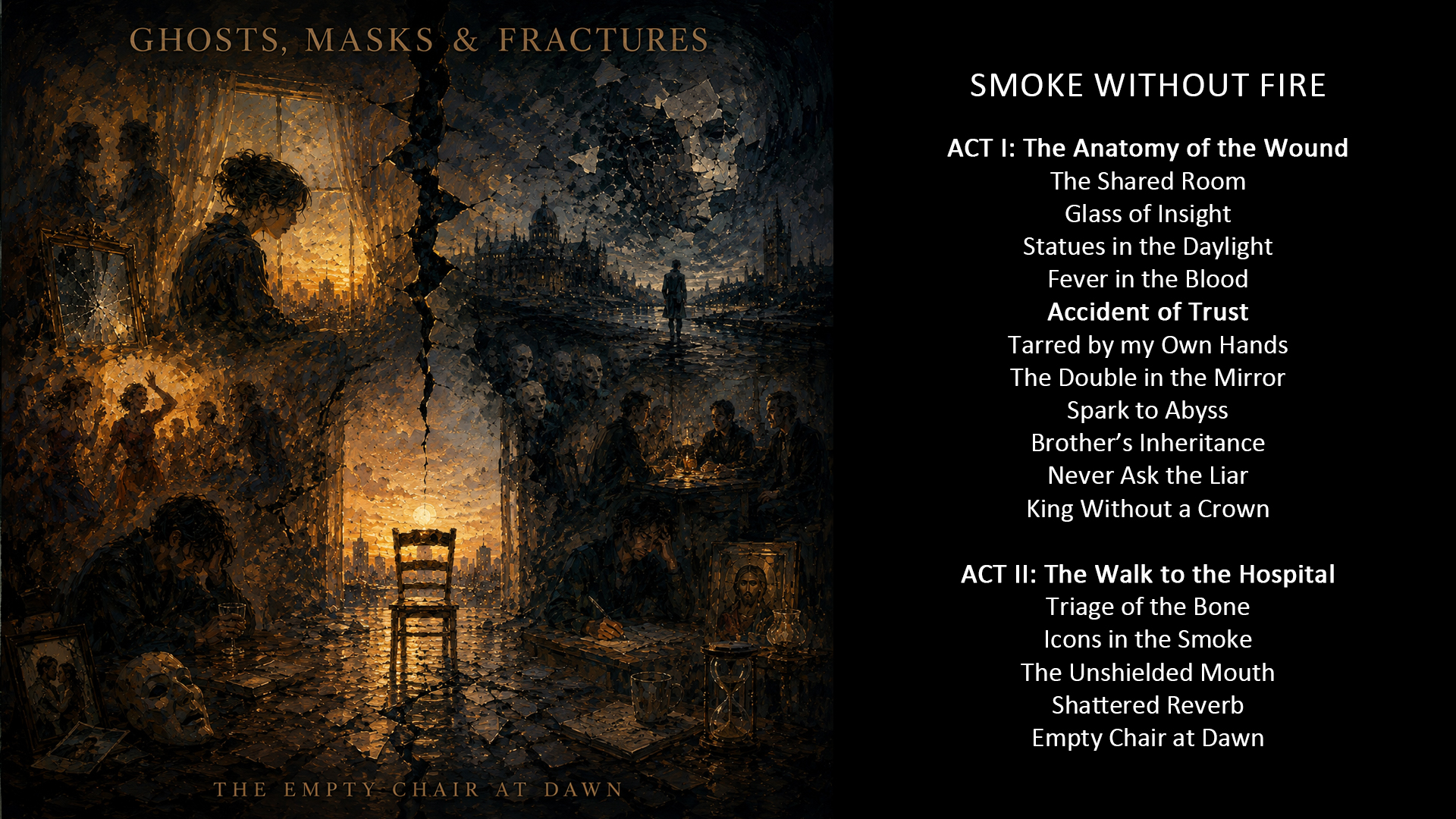

Album Review: A Dostoevskian Reckoning — On The Shared Room and Its Long Walk to the Dawn
There is a particular kind of concept album that announces its ambitions and then quietly fails to earn them — that borrows the costume of a Great Idea without doing the work the idea demands. This is not that album. Across its two acts, this record builds one of the most sustained and genuinely earned engagements with Dostoevsky’s moral universe I’ve encountered in any medium, popular or literary, and it does so not by name-checking Crime and Punishment for credibility but by inhabiting the actual psychological and theological territory Dostoevsky spent his life mapping: self-deception, guilt, anger, the divided self, infernal love, generational wound, the mechanics of the lie, and — finally, hard-won — grace.
Act I: The Anatomy of the Wound
The album opens in a marriage that has curdled into mutual performance. The Shared Room sets the terms immediately: two people “breathing the same silence,” wearing “familiar skin” like strangers, and then — in a startling whispered bridge — Father Zosima’s warning from The Brothers Karamazov breaks through the song’s fiction directly: above all, do not lie to yourself. It’s a bold move, and it works, because the album spends the next ten songs proving the warning correct in real time.
Glass of Insight and Statues in the Daylight form a quiet, devastating pair — the suffering of excessive lucidity and the loneliness it produces, and the unbearable need for a witness adequate to that lucidity. (“Not a mirror with my reflection / not a ghost that never replies” is as precise a definition of genuine encounter as I’ve heard in a lyric.) Fever in the Blood takes Dostoevsky’s understanding of guilt as a physiological event — the way Raskolnikov’s body betrays him before his conscience does — and stages it inside a marriage bed, where unconfessed sin becomes literal heat under the skin.
Accident of Trust is the album’s emotional fulcrum in its first half: betrayal rendered not as drama but as quiet corrosion — “no screaming brakes, no shattering glass” — and the unbearable image of driving forward with a ghost rotting in the passenger seat. Tarred by My Own Hand does something genuinely clever, running the old Br’er Rabbit folktale through Dostoevskian theology of pride and rage, and arriving at the only honest place such a story can end: broken and kneeling, not victorious.
The Double in the Mirror and Spark to Abyss push the album into its most ontologically unsettled territory — the split self from Dostoevsky’s The Double, and the Nastasya-Filippovna-grade conflagration of love that knows it’s destroying itself and leans closer anyway. The Brothers’ Inheritance widens the lens to family and legacy, and Never Ask the Liar functions as the act’s self-aware summary, naming the single thread running under all of it: the lie, and what it costs to keep asking a question it can never honestly answer. Act I closes with King Without a Crown — the album’s only song addressed outward rather than inward, a portrait of narcissism as Dostoevskian fortress-building, ending on Belshazzar’s wall and a question the record refuses to answer for you: did the door slam shut, or did it slam open?
Act II: The Walk to the Hospital
Where Act I diagnoses, Act II treats — and does so through a structuring idea the writer develops with real theological precision: the courtroom versus the hospital. Triage of the Bone is the album’s most personally exposed song, and its central image is exact: a person raised in a guilt-based, individualist, adversarial culture trying to inhabit an honor-based, communal, medical understanding of sin and healing, and discovering that the old architecture is “etched in my spine like an old scar” long after the mind has endorsed something gentler. “Where does it hurt?” the Physician keeps asking. The speaker keeps drafting a defense instead.
Icons in the Smoke is the album’s most beautiful song, and its quietest argument: that beauty — Dostoevsky’s “beauty will save the world” — operates not by winning an argument but by standing, unshaken, patient through every fire, until the walls built to keep it out simply have nothing left to push against. The Unshielded Mouth is confession itself, dramatized with unusual honesty — refusing both triumph and despair, landing instead on the only adequate description: “I am not better than I was. I am only real, at last.” Shattered Reverb takes a hard left into the present tense, recasting the Underground Man as a man with a phone, and finding in guitar feedback the most vivid possible metaphor for the algorithmic echo chamber — a note that “eats itself” until it is no longer music but force.
And then, finally: Empty Chair at Dawn. The album does not lie to you here, in keeping with everything it has said about lying. The chair stays empty. The wound does not close. The brothers do not reconcile. What the song offers instead is smaller and far more durable than a resolved plot: the dawn keeps returning, regardless of whether anything has been earned, and “that is enough.” It’s the same gesture Dostoevsky makes at the end of Crime and Punishment — he doesn’t show us Raskolnikov healed, only the threshold where healing becomes thinkable for the first time — and the album has the nerve to end there too, rather than manufacturing a comfort it hasn’t earned.
What Makes It Work
What separates this record from a concept album merely decorated with literary references is its refusal of the easy outs at every turn. It will not let its narrator be only a victim — “my silence is a weapon and so is his the same.” It will not let confession produce instant healing. It will not let conversion erase the old self’s nervous system. It will not let the most devastating betrayal stay melodramatic; it insists on the quiet rust of “no screaming brakes.” Every time the songs could reach for catharsis, they reach instead for honesty, and the two are not always the same thing.
The recurring motifs — the icons watching through smoke, the cracked cup and bent spoon, the shared room itself — accumulate real weight because they are never used decoratively. They return, altered in meaning but not in form, the way real grief does: the cup is still cracked at the very end. It has simply, finally, been set down in repose instead of gripped like evidence.
This is an album about what it costs to stop lying — to yourself, to the people you love, to the version of your own history you’ve curated like a private museum — and what’s actually available once you do. Not triumph. Not ruin. Something closer to what Dostoevsky’s Zosima promised and what this record, against considerable odds, earns: mercy that knows the scar, and stays anyway.
For fans of: concept albums with literary backbone, anyone who has read The Brothers Karamazov and felt strangely seen, songwriting that treats faith and failure as the same subject.
Listen for: the whispered Zosima line that opens the record and the way it resurfaces, transformed, three more times before the album is through.
Leave a Reply