
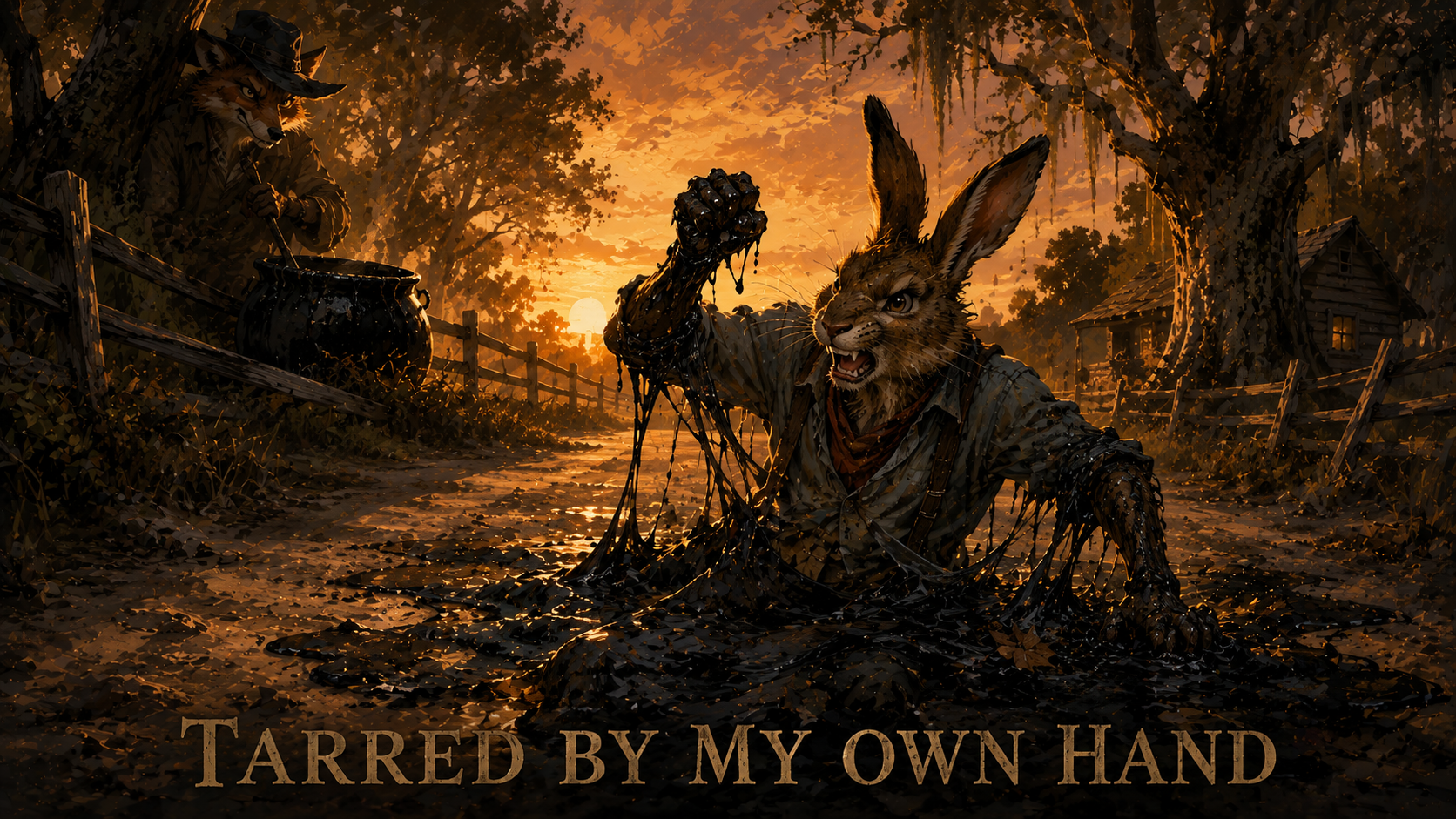
The Trap That Wears Your Face: Dostoevsky, the Tar Baby, and the Theology of Wrath in Tarred by My Own Hand
Introduction
There is a moment in The Brothers Karamazov when Dmitri Karamazov — drunk, raging, half-mad with jealousy — arrives at the house of a man he believes has stolen his beloved. He carries a brass pestle. He is, by any reasonable accounting, capable of murder. What stops him is not a decision, not a moral argument, not a sudden access of reason. It is an image: the old man’s bloodied head in the moonlight. Something breaks open in Mitya that the anger had sealed shut. He throws down the pestle and runs.
Dostoevsky spent decades studying the moment before that image — the escalation, the self-justification, the way anger wraps itself in the language of justice until the person inside it cannot distinguish between the two. His insight, repeated across his major works, was that anger is not primarily a response to an external event. It is an internal event that uses the external world as its occasion. The person who strikes out in fury is not, at bottom, responding to the thing that provoked them. They are responding to something in themselves — a pride, a wound, a demand for recognition — that the provocation merely revealed. And every blow struck in that condition tightens the trap, not on the enemy, but on the person swinging.
Tarred by My Own Hand takes the old folktale of Br’er Rabbit and the Tar Baby — a story of a trick, a provocation, and an escalating series of self-entrapments — and runs it through exactly this Dostoevskian understanding of anger’s mechanics. The result is something Joel Chandler Harris could not have imagined and Dostoevsky would have recognized immediately: a parable about the way wrath defeats itself, about the trap that is built not by the enemy but by the self that insists on answering, and about the only exit available — which is not victory but surrender, not strength but the breaking of the hands that kept striking.
I. The Fox’s Trap and the Provocation of Silence
Before Br’er Rabbit appears in the song, the stage is set with careful attention to the mechanics of the trap itself:
Br’er Fox stirred his poison / Of tar and cold vengeance / Still as a gravestone / Grinning out of sight / He planted that black-eyed devil / Then melted into night
The Fox is not a villain in any simple sense in this reading — he is the catalyst, the occasion for the trap, but not its architect in any final accounting. What he plants is a provocation: something that will respond to anger with silence, and to silence with the unbearable pressure of being ignored. “Still as a gravestone” — the Tar Baby’s power is its absolute passivity. It does not attack. It does not insult. It simply exists, and its existence, its refusal to respond, becomes the instrument of Rabbit’s destruction.
Dostoevsky understood this mechanism with precision. In Notes from Underground, the Underground Man’s defining wound is not that people hate him but that they don’t see him — that he passes through the world without registering, that his presence fails to generate the reaction that would confirm his existence. The officer who shoves him aside in the street does not do so with malice; he simply doesn’t notice the Underground Man at all. This invisibility — this silence from the world — is more maddening than any direct attack could be, because it denies the angry person the one thing they most need: acknowledgment. The Tar Baby is the perfect Underground Man’s torment: a presence that refuses to witness.
“Ain’t you got no manners?” / And the venom crawled under his skin
The progression is exact: greeting refused, patience tried, dignity invoked, and then — the venom. Not from the Tar Baby. The venom crawls under Rabbit’s skin, meaning it was already there, waiting for the occasion. The provocation did not create the anger; it revealed it. This is the first of the song’s Dostoevskian recognitions: the trap was not set entirely by Fox. It was partly set by everything already coiled inside Rabbit that needed only a refusal to ignite.
II. Justice as the Costume of Rage
The chorus delivers the song’s central philosophical proposition on first hearing, and it becomes more complex with each repetition:
When anger meets anger, it calls itself right / One swing for justice, the next for the fight / The more that I strike it, the more I’m the same / The trapper and the trapped, both answering my name
“Anger calls itself right” — this is Dostoevsky’s most important psychological observation about wrath, worked through with greatest intensity in the character of Dmitri Karamazov and in the ideological murders that populate his fiction. The self-righteous angry person does not experience their anger as anger. They experience it as justice. The moral emotion — the feeling of being wronged, of deserving better, of having a legitimate grievance — is real. The grievance may even be legitimate. But Dostoevsky was tireless in demonstrating that the legitimacy of the grievance does not determine the nature of the response, and that anger, once engaged, quickly detaches from its original justification and begins to generate its own momentum.
“One swing for justice, the next for the fight” — the first blow can be defended. By the second blow, something has shifted. The cause is no longer the point. The fight is the point. And by the fifth blow, the tenth blow, the twentieth blow — when both paws are stuck and both feet are embedded and the whole body has been hurled into the tar — the original grievance is irrelevant. What is happening is no longer a response to the Fox’s trap. It is Rabbit versus Rabbit, the angry self versus the self that is being destroyed by the anger.
“The trapper and the trapped, both answering my name” — this is the line that most directly translates the folktale into Dostoevskian moral philosophy. The insight is not merely that Rabbit is trapped. It is that Rabbit is also the trapper. The Fox planted the Tar Baby, yes — but the trap that holds is Rabbit’s own anger, his own pride, his own incapacity to suffer the silence of being ignored. The Fox walked away. The trap that remains is the one Rabbit is building with each successive blow. “Both answering my name” — both the one who set the trap and the one caught in it are, at this point, the same person.
III. The Underground Man’s Escalation
Verse 2 is a masterclass in the phenomenology of escalating anger, and it maps almost exactly onto the Underground Man’s account of his own psychological spirals:
He swung with his right paw / It clung like a blood vow / He tore with his left / Now both hands won’t come out / He kicked and he cursed, he thundered and spat / Every hot-blooded answer just tightened the trap
“Every hot-blooded answer just tightened the trap” — the Underground Man knows this. He knows it while he is doing it. He describes, with excruciating precision, the experience of watching himself escalate, of knowing that each response makes things worse, of being unable to stop responding. His consciousness is high enough to see the trap; his will is not free enough to refuse it. He is caught not by the tar but by the argument with the tar, by the refusal to accept the indignity of being ignored, by the demand that his anger be taken seriously and answered.
“The more that he fought it, the more he became / The very thing he hated — and answered to it just the same” — this is the Dostoevskian irony of righteous anger pushed to its logical conclusion. The person who defines themselves by opposition to something becomes, through the intensity of their opposition, increasingly shaped by the thing they oppose. Raskolnikov’s “extraordinary man” theory is built in opposition to the ordinary moral world he despises — and the murder he commits in the name of that theory makes him, paradoxically, more subject to the moral world’s judgment than anyone. The rebel against the law becomes the law’s most vivid illustration. Rabbit, fighting the embodiment of Fox’s cold vengeance, becomes cold and vengeful.
The pre-chorus that follows compounds this with one of the song’s most striking images:
He wrestled his own shadow / In the hell he helped sow
“Wrestled his own shadow” — this is the Underground Man’s essential activity, rendered in the Tar Baby’s framework. The shadow is not the Fox. The Fox is gone. The shadow is the part of Rabbit that the anger has activated and cannot now quiet — the pride, the need for acknowledgment, the refusal to accept that the silent black figure in the road has more power over him than he has over himself. He is fighting himself. The hell is partly Fox’s making and partly Rabbit’s. “He helped sow” — not entirely his fault, not entirely his choice, but not not his either.
IV. The Bridge: The Gallows You Call Sacred
The bridge is the song’s philosophical center, and it asks the questions that Dostoevsky’s characters most rarely allow themselves to ask until the breaking point:
What kind of trap is this / That wears my own face? / When fury builds a gallows / And calls it a sacred place
“Fury builds a gallows and calls it a sacred place” — this is the self-righteous anger of Dostoevsky’s most dangerous characters rendered in its most compressed form. Ivan Karamazov’s rebellion against God is built on a gallows — the suffering of innocent children — that he calls sacred in the sense of inviolable, too serious to rationalize away. His anger is, in many respects, correct. The injustice is real. But the gallows he builds from it — the intellectual structure of rebellion, the refusal of forgiveness, the demand for a justice that will satisfy his outrage — begins to destroy him from within, because it is a sacred place that has no mercy in it, and a person who lives in a sacred place with no mercy is a person who has built themselves a magnificent prison.
“How many times must I strike / At a devil that won’t speak / Before I see these bleeding hands / Are the noose that I keep?” — the noose the speaker keeps is not imposed from without. It is a possession, something carried, something returned to. Every time the anger rises and the blow is struck, the noose is drawn a little tighter. The devil that won’t speak is not punished by the striking. Only the striker is.
This is Dostoevsky’s answer to the Grand Inquisitor’s argument as much as to Rabbit’s predicament. The Inquisitor builds his case against Christ on irrefutable premises — human weakness, the cruelty of impossible freedom, the necessity of bread before ideals. He is not wrong about any of it. But the gallows he has built from these truths, the system of controlled unfreedom he administers, has cost him everything that makes life worth having. He has been striking the silent Christ for fifteen centuries. His hands are bleeding. He is the trap.
V. Pride as the Tar: Dostoevsky’s Diagnosis
The outro performs the song’s most important theological move, and it is the one that most directly places it in the tradition of Dostoevsky’s religious anthropology:
The snare isn’t tar — / It’s the pride in my chest / Fury weds its own grave / But mercy might save what is left
“The snare isn’t tar” — the song corrects its own central metaphor. The Tar Baby is a vehicle, not a substance. The actual trap is identified: pride. Not vanity, not arrogance in the conventional sense, but the deeper thing Dostoevsky understood pride to be: the refusal to accept that one can be ignored, can be disrespected, can be wronged, without being thereby diminished. The pride that will not suffer silence. The pride that demands that its anger be answered.
In Dostoevsky’s moral theology — developed most fully through Father Zosima and Alyosha in The Brothers Karamazov — pride is the root of all the spiritual diseases he diagnosed. Not sexuality, not violence, not even murder. Pride: the posture of the self that places its own dignity above its capacity for love, that would rather be right than be merciful, that would rather build a gallows and call it sacred than kneel and acknowledge its own participation in the world’s suffering.
“Fury weds its own grave” — a line worthy of Dostoevsky at his most aphoristic. Anger is not merely self-defeating in a practical sense. It is suicidal in a spiritual sense. The self that is entirely organized around its wrath has married the instrument of its own destruction and called it a vow. There is no betrayal, no accident of trust, no external crash — only the steady advance toward the grave that the anger itself is digging.
“But mercy might save what is left” — the might is everything. Not will, not does, but might. The mercy is not guaranteed. The breaking may come too late, or not at all. But the possibility is present, and in Dostoevsky’s moral universe, the presence of the possibility is already a form of grace — the crack in the prison wall through which light enters if the prisoner can bear to turn toward it.
VI. Broken and Kneeling: The Moment of Dostoevskian Conversion
The final lines of the outro perform a movement that Dostoevsky dramatized repeatedly, and that he considered the most important movement available to the human soul:
I struck at the shadow / Till my hands ran with blood / Now broken and kneeling / I see the face of God
“Broken and kneeling” — this is the position of Raskolnikov at the crossroads when he bows to the earth at Sonya’s urging. It is the position of Mitya Karamazov in the cart taking him to prison, weeping for the frozen baby in the dream he has just had, weeping for all suffering everywhere, feeling for the first time in his life something larger than his own outrage. It is the position of the Prodigal Son in the parable that Zosima returns to repeatedly — the position arrived at not through virtue or decision but through the complete exhaustion of all the alternatives.
“Till my hands ran with blood” — the hands that struck are the hands that are broken. The violence of the anger has turned on the violent person. This is not punishment from without; it is the logical conclusion of the path the anger chose. The hands are bleeding because they kept striking. There was no external judgment, no cosmic enforcement — only the tar, and the pride, and the inevitable conclusion of the combination.
“I see the face of God” — this is the moment that Dostoevsky spent his whole career trying to make credible against every intellectual objection his characters could raise. Ivan Karamazov cannot see the face of God because he will not kneel — because the pride of his rebellion, however justified, keeps him upright and therefore keeps him sealed. Raskolnikov cannot see it until Sonya reads to him, until the Siberian wind is in his face and he has finally, finally run out of theory. The moment of vision comes not at the height of spiritual development but at the bottom of spiritual exhaustion — when everything else has been tried and failed, when the hands are bleeding and the body is in the dirt, when there is nothing left to do but look up.
This is what Dostoevsky meant when he said, through Zosima, that hell is the incapacity for love — not a punishment externally imposed but a condition internally maintained, a choice to keep striking rather than to stop and be still and allow something other than the anger to be present. The exit from hell, in this framework, is not an escape but a surrender: the moment when the person on the road finally stops fighting the Tar Baby and becomes, for the first time, genuinely still.
VII. The Stillness Between the Spark and the Flame
The song’s most explicitly theological petition appears just before the final revelation:
So teach me the stillness / Between the spark and the flame / To suffer the silence / And call it by my name
“The stillness between the spark and the flame” — this is the space that Dostoevsky’s psychology locates as the site of all moral choice. Not the moment of the spark (the provocation, the anger arising) and not the moment of the flame (the blow struck, the word hurled, the body thrown into the tar) but the infinitesimal gap between them, where something other than the anger might be possible if anything can reach the person in time.
The Underground Man lives in the spark. He cannot find the stillness. His consciousness, for all its acuity, cannot locate the space between the provocation and the response, because his pride fills that space completely, because his need to be right crowds out everything else.
Zosima’s teaching, and Alyosha’s practice, is precisely the cultivation of this stillness — the capacity to suffer being disregarded, to bear the silence of the Tar Baby, without being destroyed by it. “To suffer the silence / And call it by my name” — to own the silence as part of one’s own experience, not as an affront imposed from without. The silence is not the enemy. The silence is the occasion for discovering whether one’s identity is stable enough to survive not being answered.
In Dostoevsky’s terms: the person who can suffer the silence without swinging is the person who has found something more fundamental to rest on than the recognition of others. The person who cannot — the person who must swing, who must answer, who must force the encounter — is the person who has made other people’s attention the foundation of their existence, and who will be destroyed, inevitably, when that foundation is deliberately withheld.
VIII. The Folktale Redeemed: What Dostoevsky Does to Uncle Remus
It is worth pausing to consider what the song has done to its source material, because the transformation is philosophically significant.
In the Uncle Remus telling, the Tar Baby story is essentially comic — and the comedy is partly at Rabbit’s expense, but ultimately Rabbit escapes through his wit, tricks Br’er Fox into throwing him into the briar patch, and the story ends in laughter and triumph. The Tar Baby is a trick that fails; cunning defeats vengeance; the clever survive. It is a story with a horizontal moral: use your head, not your fists.
Dostoevsky — had he written it — would have refused this ending, not because he was humorless but because he was interested in a different and deeper question than whether the clever outwit the vengeful. He was interested in what the anger reveals about the person who experiences it, and what can be learned in the trap that cannot be learned in the escape from it. His Rabbit does not trick his way out. His Rabbit strikes until his hands bleed, and then kneels in the dirt, and then — broken by the anger he was never going to win — sees something he could not have seen from the briar patch.
The folktale asks: how do you escape the trap? Dostoevsky asks: what does the trap show you about yourself? And the answer, in Tarred by My Own Hand, is the most uncomfortable and the most hopeful thing in the song: it shows you that the trap was always partly yours, that the pride in your chest was the tar, and that the breaking of your hands is not the end of the story but the beginning of the only part of it that matters.
Conclusion: Both Names on the Trap
Tarred by My Own Hand is the most formally surprising song on the album, and in some ways the most complete Dostoevskian statement it contains. Every other song in the first act has examined the damage that is done to people by the choices and failures of others: the shared room of mutual deception, the loneliness of the glass of insight, the longing for a witness, the embodied guilt of a secret, the crash of trust. This song asks a different and harder question: what damage do we do to ourselves, from the inside, with the hands we were given?
The answer it arrives at — through the red-clay road and the split-rail fence and the old American folktale and the Dostoevskian theology of pride and grace — is that the angriest person in any encounter is always fighting on two fronts simultaneously: against the enemy in front of them and against the trap they are building with their own response. And the only way out of the trap is the way Dostoevsky’s greatest characters find the only way out of anything: through the bottom, through the complete failure of all the alternatives, through the bleeding hands and the broken body and the kneeling in the dirt and the upward look that is not triumph but its opposite — the acknowledgment that the self, alone, in the purity of its righteous fury, was never going to be enough.
The trapper and the trapped. Both answering the same name. Broken and kneeling. And mercy — maybe — for what is left.
Leave a Reply