
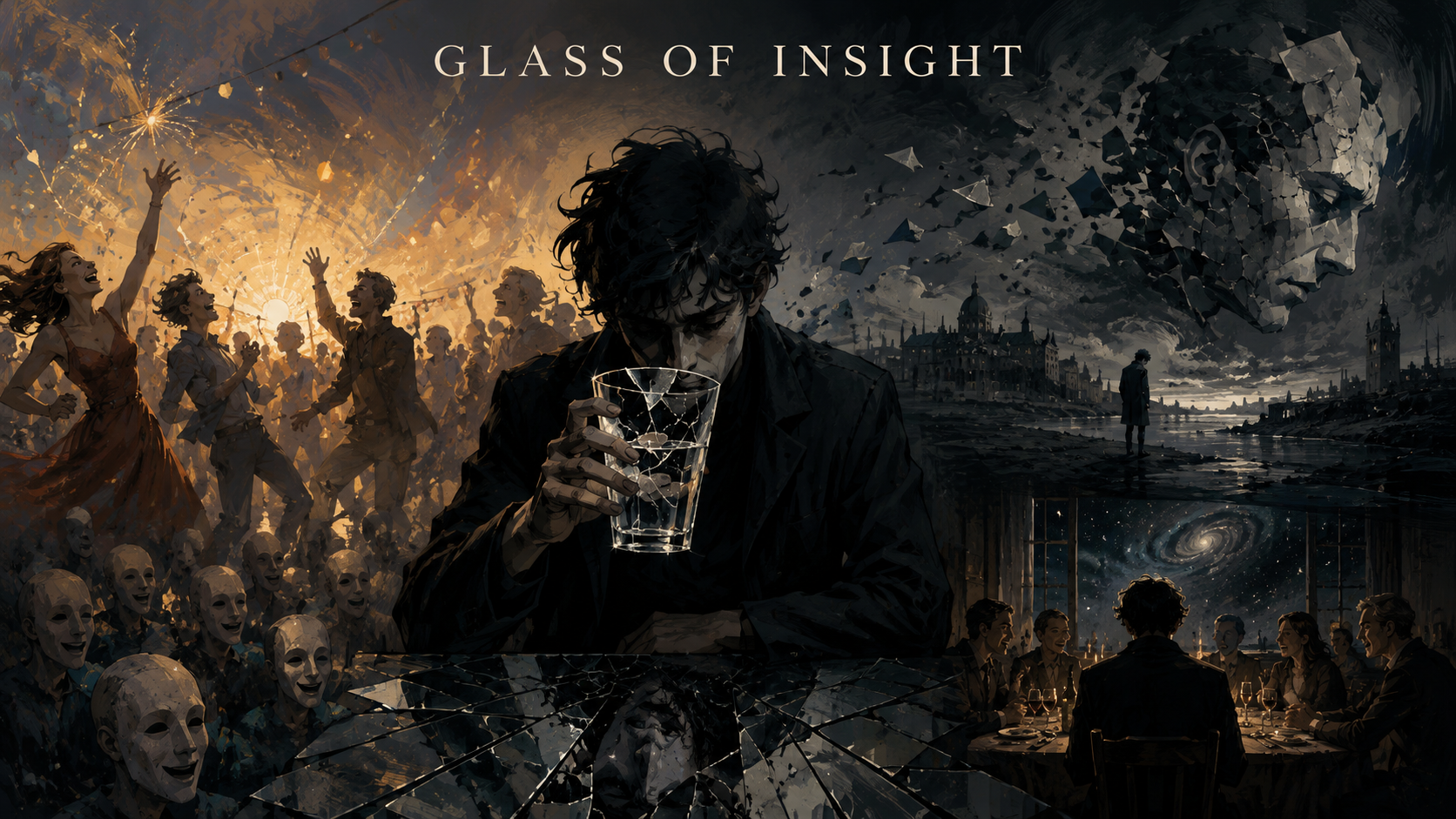
The Wound of Knowing: Dostoevskian Philosophy in Glass of Insight
Introduction
Dostoevsky believed that consciousness was a disease. Not metaphorically, and not entirely in condemnation — but as a clinical, almost physiological observation about what happens to the human organism when it develops the capacity to see clearly. His Underground Man puts it most nakedly: “I swear to you that to think too much is a disease, a real, actual disease.” The man who thinks, who perceives, who refuses the comfortable sedation of ordinary life, pays for his clarity with his belonging, his peace, and ultimately his ability to act.
Glass of Insight is a song written in the exact register of this Dostoevskian wound. It takes as its twin epigraphs two observations — one attributed to the novelist’s philosophical orbit and one drawn directly from Crime and Punishment — about the relationship between intelligence and suffering, between depth of perception and depth of loneliness. But the song does not merely illustrate these quotes. It dramatizes them from the inside, in the voice of someone living the experience in real time: at a dinner table, in the silence after a conversation that didn’t happen, in the terrible moment when understanding a room makes you a stranger in it.
What follows is a close reading of the song’s Dostoevskian architecture.
I. The Underground Man and the Curse of Hyper-Consciousness
The first principle of Dostoevskian psychology, worked out most fully in Notes from Underground (1864), is that heightened awareness and heightened suffering are not merely correlated — they are the same thing experienced from two angles. The Underground Man’s famous formulation: “Every sort of consciousness is a disease.” He does not mean that ignorance is preferable in some simple sense. He means that the person who truly perceives — who cannot filter reality through the comforting distortions that allow most people to function — has been cursed with a faculty that extracts a permanent tax.
Glass of Insight opens in precisely this phenomenology:
I read the cracks in faces / Trails behind the eyes / Every truth I gather / Cuts a little deeper
“Cracks in faces” and “trails behind the eyes” — this is not ordinary social perception. This is the compulsive, involuntary hyper-reading of a consciousness that cannot turn itself off. The verb “gather” is important: truth here is not sought as wisdom but accumulated the way a body accumulates scar tissue — passively, through exposure, at a cost. Each new perception does not make life easier or the speaker more capable; it “cuts a little deeper.” The metaphor anticipates the central image of the song — the glass that cuts — but here the cutting is incremental, the slow laceration of chronic lucidity.
The Underground Man would recognize this immediately. His tragedy is not that he is wrong about the world — he is almost always right — but that being right does not help him. Knowledge, in his experience, does not produce power or peace; it produces paralysis and isolation, because he can see every possible objection to every possible course of action, and because his perception of other people’s motives makes genuine connection feel like a performance he cannot sustain.
The pre-chorus of Glass of Insight names this dynamic with unusual directness:
And the more I see / The less I belong / Answers don’t warm me / They only sharpen the wrong
“Answers don’t warm me” — this is the key. The conventional promise of intelligence and understanding is that it leads somewhere useful, that it provides comfort, orientation, or power. The Dostoevskian insight, enacted here, is that it does none of these things. Answers, in this framework, are not solutions. They are additional wounds. Each one sharpens the speaker’s sense of what is wrong with the world, with the people around them, with the room they are standing in — without providing any remedy. The temperature metaphor (“warm”) is important: knowledge here is cold. It illuminates without heating.
II. The Happy Fool and the Suffering Lucid
One of the two epigraphs that generated this song articulates what may be Dostoevsky’s most uncomfortable social observation: “That’s why fools are happy, and intelligent people live in loneliness.” This is not a bitter complaint from a failed misanthrope. It is a structural claim about the relationship between perceptual capacity and social belonging.
Dostoevsky dramatized this across his fiction. Prince Myshkin in The Idiot — whose very nickname signals the paradox — is the most purely good and most purely perceptive character in the novel, and precisely because of this he cannot survive in St. Petersburg society. His goodness and his insight are the same quality: he sees people as they actually are, without the defensive filtering that allows social life to proceed. This makes him a kind of saint and a kind of fool simultaneously — “idiot” in the original Greek sense of idiotes, the private person who stands outside the common life.
Glass of Insight returns to this paradox repeatedly, and most concisely in the chorus:
Fools dance lightly / I stand alone
The image of fools dancing is not contemptuous — it is genuinely envious, and the envy is what gives it its Dostoevskian weight. The speaker does not hate the dancers. They watch them the way Myshkin watches the Petersburg socialites: with longing for a lightness they cannot access, a belonging they cannot fake. “Dance lightly” — the adverb is everything. Lightness is precisely what knowledge has taken from the speaker. Every truth gathered adds weight. Every crack read in a face adds gravity. The fools dance because they are not carrying what the speaker is carrying.
Verse 2 extends this with a sharper edge:
They walk through fire / Call it grace / Kissing their shadows / Call it faith
This is not simply anti-religious skepticism. It is a Dostoevskian observation about the function of self-deception in ordinary life. “Kissing their shadows” — worshipping not the thing itself but its silhouette, the comfortable projection rather than the difficult reality. In The Brothers Karamazov, the Grand Inquisitor accuses Christ of overestimating humanity: people do not want freedom and truth, he argues — they want miracle, mystery, and authority. They want the fire rebranded as grace. They want their shadows to kiss back. The speaker of Glass of Insight has lost the capacity for this, and what remains is not superiority but bereavement. They hear the rot in every “yes” and the scorn in every bless — not because they want to, but because they cannot help it.
III. Petrification: The Image of the Glass
The song’s central metaphor — the glass of insight — carries a specific and complex weight that rewards examination. Glass is the medium of both clarity and severance. It lets you see while keeping you apart. A window is glass; so is a wall. A lens sharpens the image and simultaneously confirms the distance between the observer and the observed.
The glass here is also a vessel — something you drink from — and what it contains is, explicitly, a poison:
So I drink this bitter vision / Though it hollows out the room
Drinking bitter things for the sake of what they reveal is an ancient motif, but in the Dostoevskian context it takes on a specific character. Raskolnikov, in Crime and Punishment, cannot stop thinking his terrible thoughts even when he knows they are destroying him. He cannot undrink the idea of the extraordinary man, the idea that some individuals are beyond conventional morality. The insight is the poison, and he has already swallowed it.
But the most important property of the glass in this song is what it does to its drinker over time. The chorus repeats the phrase:
Glass of insight / Turn me to stone
Petrification — the slow hardening of the perceiving self into something geological, something that can feel nothing — is one of Dostoevsky’s most persistent fears for his hyper-conscious characters. The Underground Man is already partially stone: he has reasoned himself out of desire, out of action, out of love, leaving only the capacity for observation and the ability to resent what he observes. The speaker of Glass of Insight watches this happening to themselves in real time. The glass cuts clean; the glass cuts again; and eventually the accumulated cuts leave not a wound but a surface, not a person but a petrified witness.
The final chorus refuses even the escape of grey or color:
No return to color / No escape from grey / Thoughts like iron / No surrender to clay
“Thoughts like iron” — the mind has become its own prison, too rigid to bend toward comfort, too heavy to lift toward joy. “No surrender to clay” — clay is malleable, workable, human. Iron is not. The speaker has been forged by their own cognition into something harder and lonelier than what they started as.
IV. Great Sadness and the Wound of Greatness
The second epigraph — “Pain and suffering are always inevitable for a large intelligence and a deep heart. The really great men must, I think, have great sadness on earth” — comes from Raskolnikov’s reflections in Crime and Punishment, and it introduces a dimension the song handles with particular care: the idea that the suffering of the lucid is not merely unfortunate but somehow necessary, even constitutive of what makes them who they are.
This is the hardest Dostoevskian position to hold without tipping into self-pity or grandiosity, and the bridge of Glass of Insight navigates it honestly:
They say the wise are heavy / That greatness wears the wound / So I drink this bitter vision / Though it hollows out the room
If knowing is a curse / I was damned from the start / Can’t unknow the weight / It’s carved into my heart
“They say the wise are heavy” — the speaker does not claim this. They report it as something they have heard, something that might console them, while the verse itself makes clear that the comfort is thin. “Though it hollows out the room” — the hollowing is real; the philosophical consolation is uncertain. “If knowing is a curse / I was damned from the start” — this is not pride but fatalism, and Dostoevsky’s fatalism about the brilliant and the suffering was always this honest: their gifts and their wounds come from the same source, and neither can be returned.
“Can’t unknow the weight / It’s carved into my heart” — this is perhaps the song’s most Dostoevskian single image. Carved, not grown; imposed, not chosen. The weight of perception is not something the speaker has acquired through error or pride. It is constitutive. This is exactly Raskolnikov’s position before his crime and after it: he did not choose to be the kind of person who thinks the thoughts he thinks. He was made this way. The sadness is not incidental to the greatness — in Dostoevsky’s formulation, it is the greatness, seen from the inside.
V. The Dinner Table and the Lost Moment
Verse 3 is the most cinematically specific moment in the song, and in some ways the most emotionally devastating — precisely because it moves from the abstract to the particular:
I sat with friends at dinner / The conversation opened wide / But the evening air grew thinner / I kept my words locked inside
This is Dostoevsky at the scale of the short story — the scene of failed human connection rendered in a few lines. The Underground Man has dozens of such scenes: moments when ordinary social life opens a door he could walk through, and he cannot make himself walk through it, and then the door closes and he is alone again. The conversation “opened wide” — the opportunity was there, real, available. But perception has made the speaker unable to enter it honestly, and dishonest entry is no longer possible.
What follows is the most formally unusual moment in the song, and one of its most philosophically significant:
Where does it lead / This tongue on a chain / Somehow it feels like… / …the universe just lost… an important moment
The ellipses, the trailing syntax, the almost cosmic scale of “the universe just lost an important moment” — this is Dostoevsky’s vision of what is actually at stake in small failures of human connection. Throughout his novels, the missed moment of genuine encounter — the word not said, the hand not extended, the confession not made — carries metaphysical weight. In The Brothers Karamazov, Alyosha’s quiet conversations with strangers change lives. Their inverse — the conversation that almost happened and didn’t — is equally consequential. The universe, in this reading, is made poorer by every authentic moment that fear or pride or the weight of too much knowledge prevents. The speaker knows this. Knowing it does not help.
VI. The Compulsion to Know Anyway
What separates Glass of Insight from mere complaint — and what makes it most fully Dostoevskian — is the final chorus’s refusal of the obvious conclusion. If knowledge causes this much suffering, the logical response is to stop seeking it. But:
Glass of insight / Burned into me / Still I need the truth / Though it buries me
“Still I need the truth” — not “still I seek it” or “still I value it” but “still I need it.” This is compulsion, not virtue. The speaker cannot choose to stop any more than Raskolnikov can choose to stop thinking about extraordinary men, or the Underground Man can choose to stop analyzing his own paralysis. The need for truth is not a moral achievement. It is a constitutional fact about the kind of person they are, inseparable from everything else about them, including all the suffering.
Dostoevsky never romanticized this. He did not think the suffering of the intelligent was noble in a comfortable sense. He thought it was real — that it was what intelligence actually cost, that the cost was genuine and not redeemable for anything, and that the person paying it could not stop paying it even if they wanted to. What he offered was not consolation but honesty: an unflinching acknowledgment that some people are made this way, that the world is organized in a way that makes their existence painful, and that the only thing left is to go on seeing clearly, to resist the temptation of the shadow mistaken for the thing, even when the clarity hollows out the room.
Conclusion: Standing Alone in the Glass
Glass of Insight arrives at its ending without resolution, because resolution would be dishonest. The speaker stands alone; the glass turns them to stone; the outro simply restates the condition without redemption:
I stand alone / Glass of insight / Turn me to stone
This is fidelity to the Dostoevskian tradition at its most rigorous. His novels do not end cleanly. Raskolnikov’s confession begins a process, not a solution. The Underground Man never gets out of the underground. Myshkin returns to Switzerland, returned to the vacancy of the idiot he was before the story began. What Dostoevsky offered was not the promise that suffering yields wisdom yields peace. He offered the more difficult and more honest proposition: that the suffering is the wisdom, that they cannot be separated, and that the person marked by this particular wound will carry it until they can’t.
The glass of insight cuts clean. The glass cuts again. And then it turns you to stone — not as punishment, but as a kind of truth about what sustained lucidity costs the body and the soul that houses it.
To understand this fully is to understand why the fools are dancing, and why you are standing still, and why — despite everything — you would not trade what you see for the lightness of not seeing it. That ambivalence, held without resolution, is the most Dostoevskian thing about the song of all.
Leave a Reply